Fujiko Nakaya – Sculpting the Fog
Presented at the Bourse de Commerce as part of the “Clair-Obscur” exhibition, the sculpture Cloud #07156 by Japanese artist Fujiko Nakaya transforms the Rotonde into a landscape of fog that is as mysterious as it is fleeting. A work created specifically for this space, introduced by Anne-Marie Dug
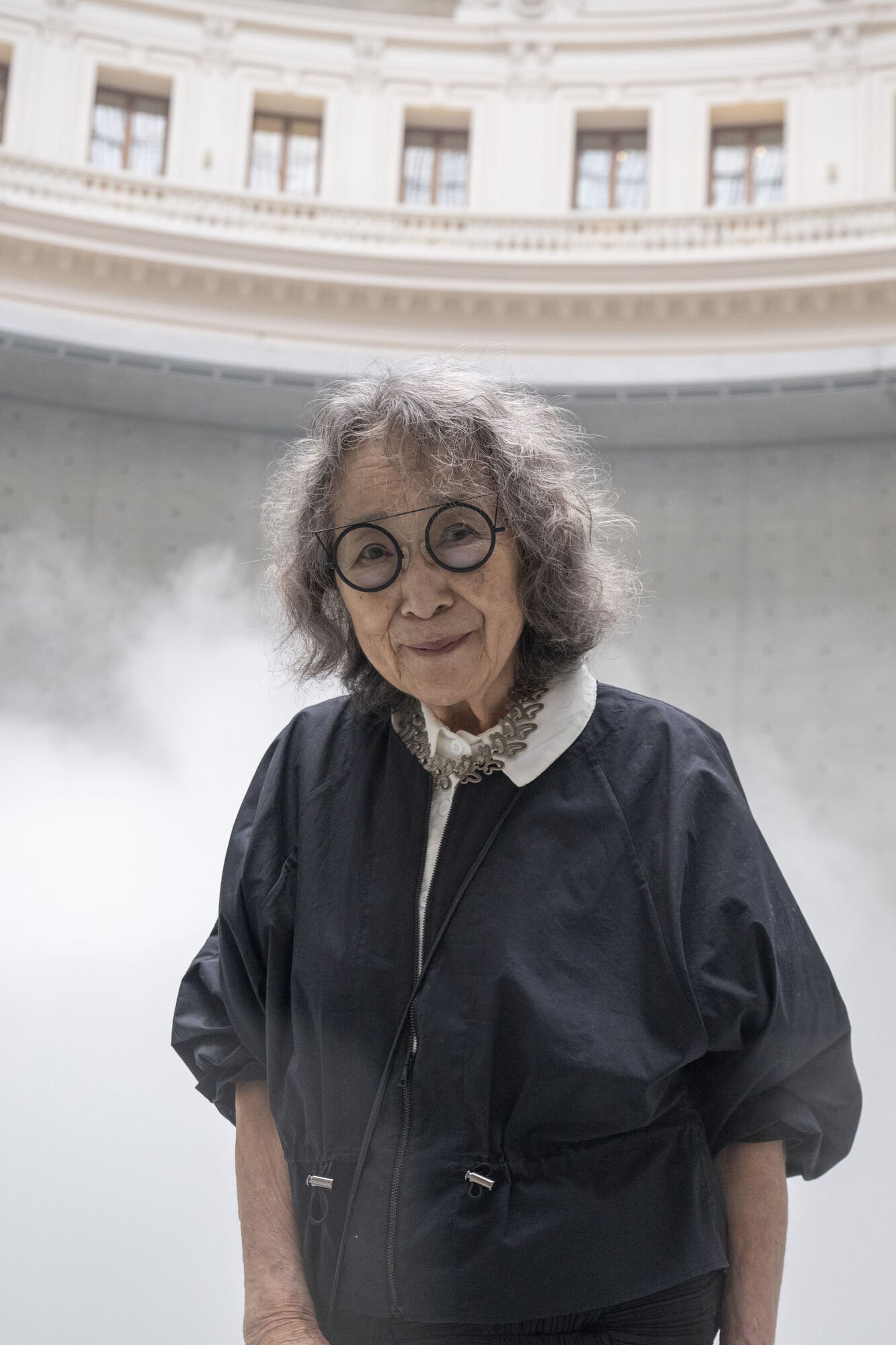
For the second sequence of the “Clair-obscur” exhibition, the Rotunda of the Bourse de Commerce is hosting a work by Japanese artist Fujiko Nakaya, Cloud #07156. Designed specifically for this space, the work draws on the concept of “fog sculptures,” which the artist has been exploring for over 50 years, both in public spaces and inside museums.
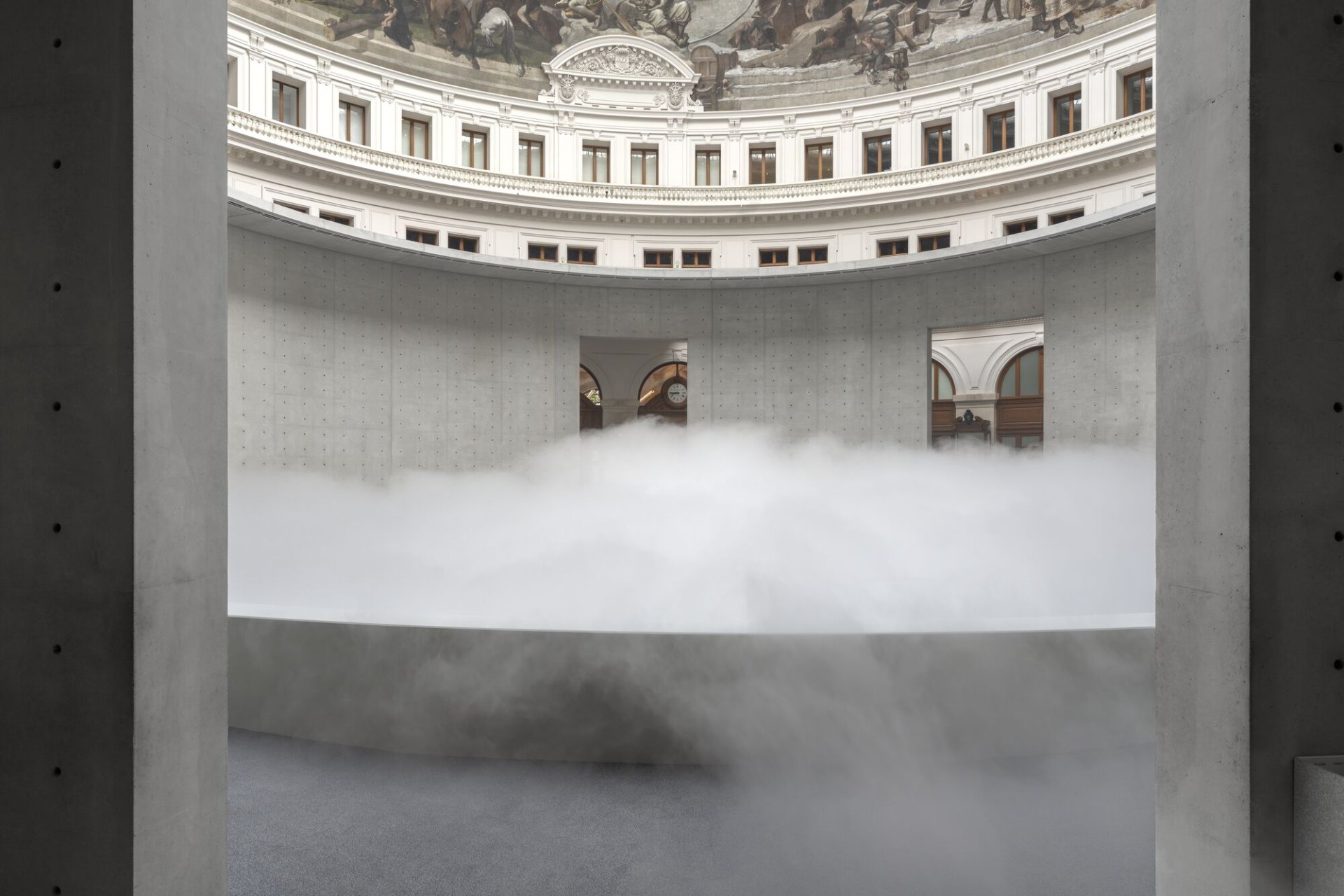
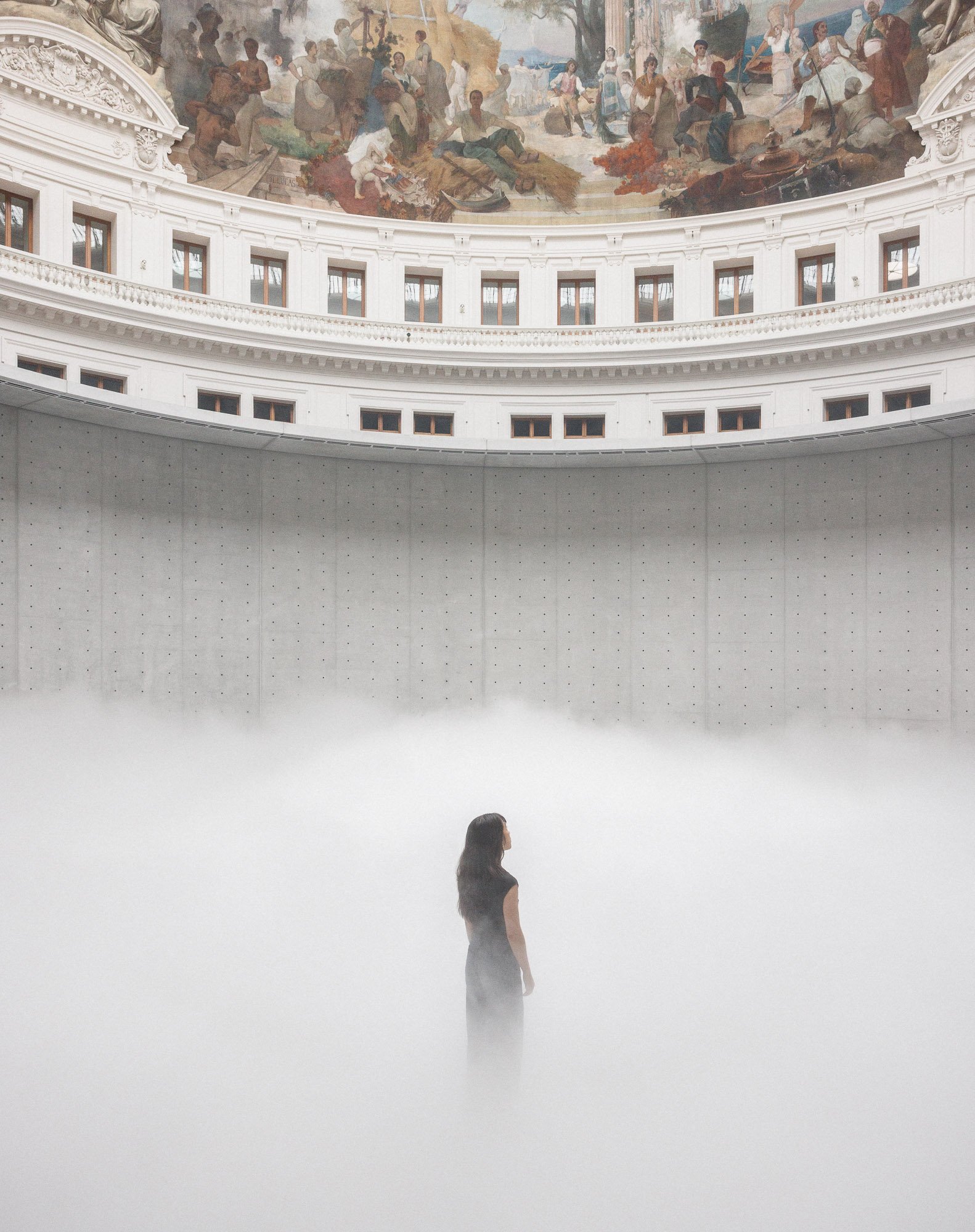
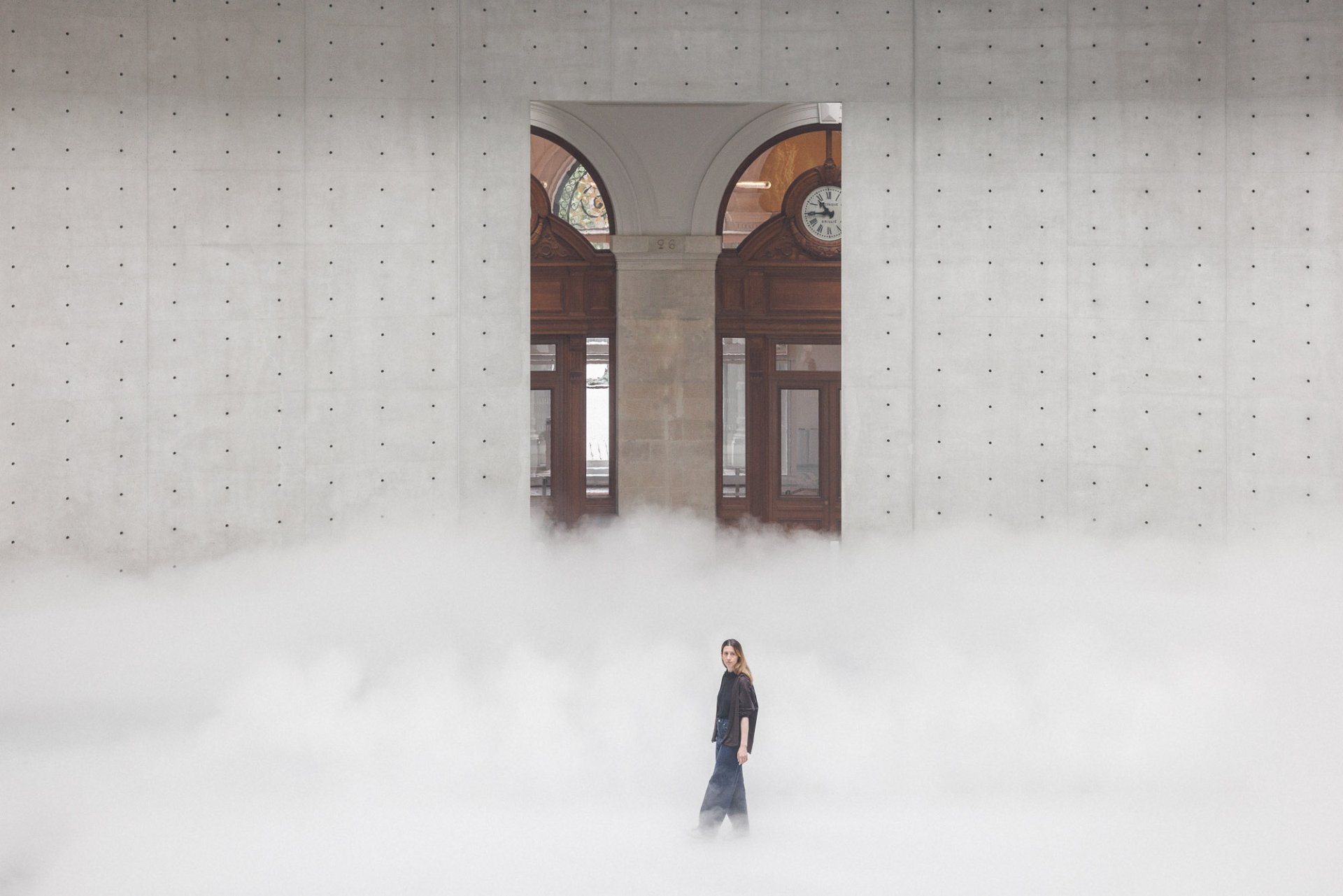
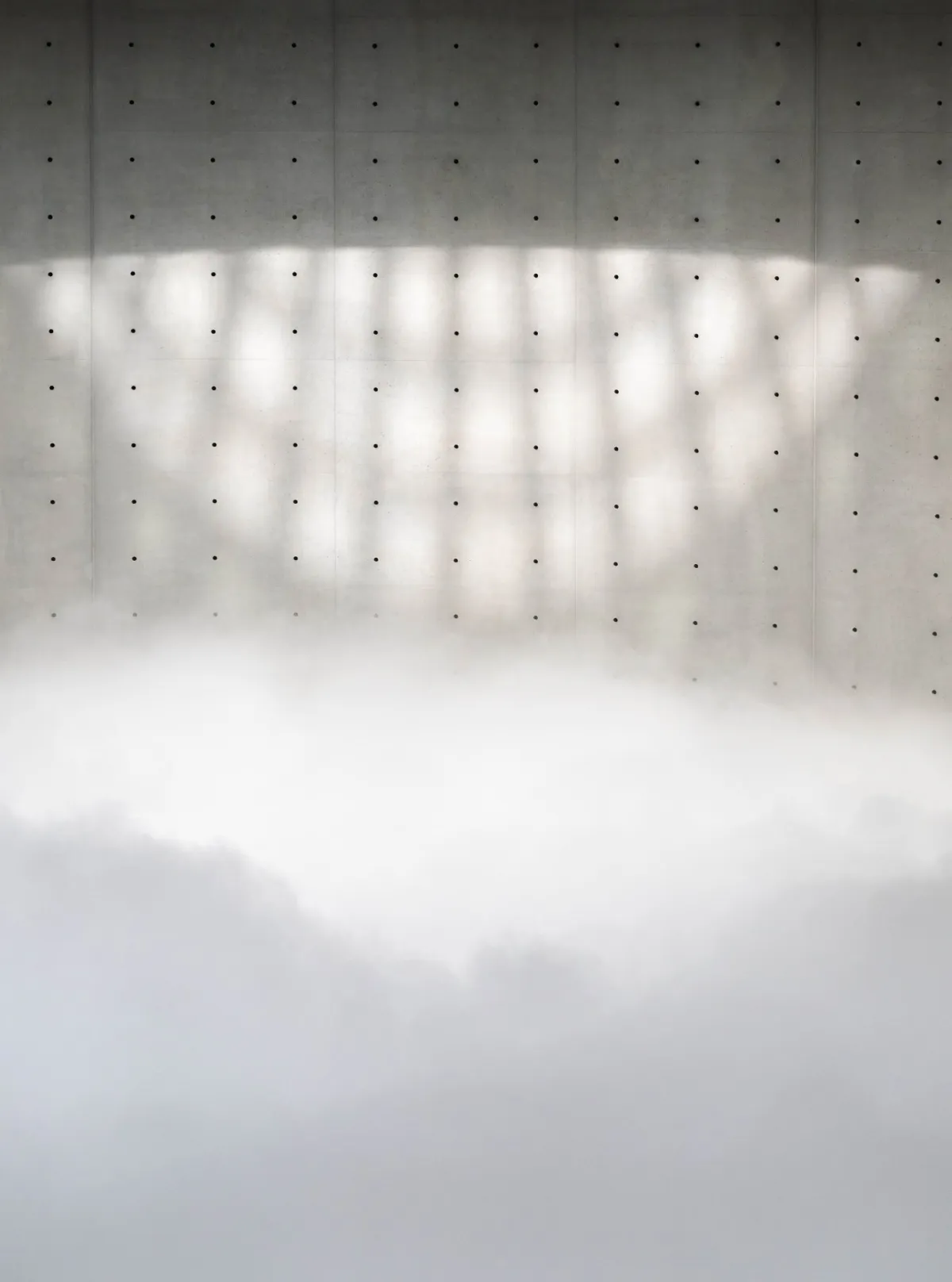
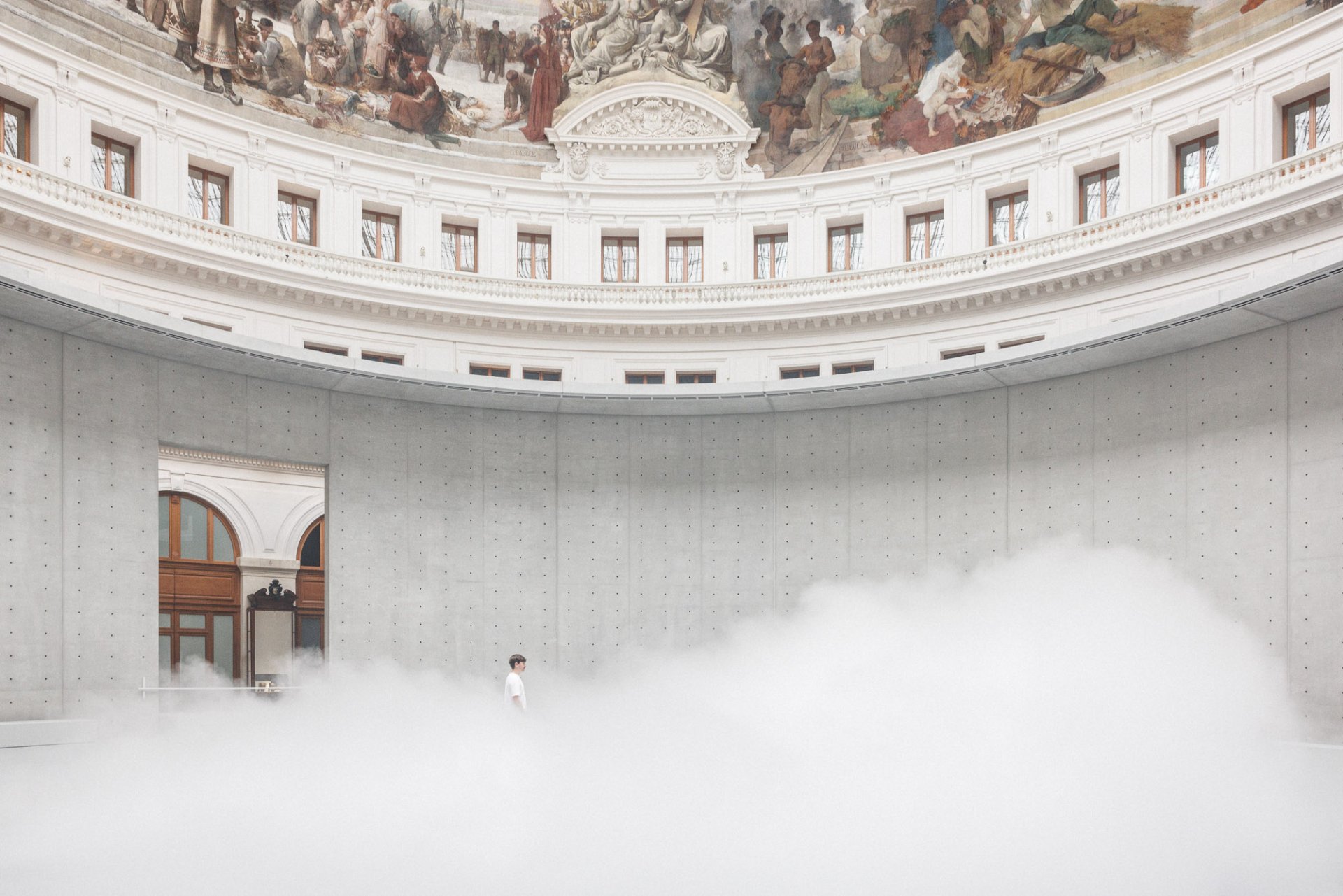
Silhouettes appear and disappear in a thick white cloud made of water vapour. The Rotunda of the Bourse de Commerce, usually so visible, was transformed into a site with uncertain contours, through the presence of a Fog Sculpture by Japanese artist Fujiko Nakaya. Always working from an existing context, the artist has created an exceptional encounter between fog and Tadao Ando’s Rotunda, indoors. Fujiko Nakaya does not represent fog, she sculpts it. This surprising material is a natural phenomenon that she produces with the aid of a complex system of high-pressure pumps and rows of pipes that emit microdroplets of water identical to those of fog. Natural in its composition and development, it is artificially produced by the artist.
“Fog responds constantly to its environment, revealing and concealing the features of the environment. Fog makes visible things become invisible, and invisible things – like wind – become visible.” — Fujiko Nakaya
When she gave up painting in the mid-1960s, it was to engage several years later in a set of ambitious experiments: the production of fog on a grand scale, now in a different space than that of her studio. She thus covered the dome of the Pepsi Pavilion at Expo ’70 in Osaka, at the invitation of Experiments in Art and Technology (E.A.T.). This would be her first major fog work. An audacious pioneer, passionate since childhood about natural phenomena and science, her curiosity is boundless. Her father, Ukichiro Nakaya – a physicist, famous for inventing a method of production of artificial snow crystals – encouraged her to listen to nature above all else. In 1969, in collaboration with engineer Thomas Mee, she invented a “system/apparatus enabling a cloud sculpture to be produced from a vaporous fog”. While this research attests to a clear environmental awareness, it also stems from a powerful artistic position that invites the public to traverse the artwork and experience it as much as they contemplate it, excluding any chemical procedure from the outset.
This fog phenomenon, naturally unstable, ephemeral and ever-changing, requires – for a domestication that is highly relative – knowledge of the physical laws of its formation and dissipation. Fujiko Nakaya, who creates most of her works for outdoor environments (over one hundred to date), studies the strength and direction of the wind for each project, the rate of humidity in the air and temperature differences at the specific location of its creation. Using this meteorological data, she develops hypotheses about the behaviour of the fog, allowing her to create a score for a complex and hypersensitive artwork, engaging in, as she puts it, “a conversation with the wind”. She orchestrates the durations and rhythms of emission of the sources of fog, programming convections, installing constraints, but she does not produce a certain form: only the possibility of a wave, a cascade or a cloud hovering
amid trees. How does the fog react when it is sculpted inside a building and it is no longer possible to cope to the same extent with the indeterminacy of the natural parameters? It is in a specific architectural context, charged with its own history, that Fujiko Nakaya has devised her work. The Rotunda of the Bourse de Commerce is a vertiginous space whose two upper levels are occupied by a panoramic, marouflage canvas, crowned with a dome. On the floor, in the centre, the concrete cylinder by Japanese architect Tadao Ando doubles the circularity of the building while remaining open to all possible points of view, both around or within the work.
The fog, the main subjectof the gaze, can therefore serve to block the view, even temporarily, acting as a kind of anti-panopticon capable of obscuring observation, permanently defying it through ephemeral and partial transparencies. The question is no longer that of the point of view – whether single or multiple – but that of visibility. From a first-floor balcony, a high-angle overview allows visitors to contemplate a sea of fog. Sculpting inside the museum also enables an inner journey: “The experience of fog sculpture sparks apowerful conversation, not just with nature but with oneself […]. Metaphysical experiences are infinite and personal. Making the visible invisible and the invisible visible – in this way, the fog sculpture instantaneously transforms its environment into an illusory space-time.”
On this new adventure, a conversation between solid and gaseous, the architecture opposes a resistance, ineluctably limiting the fog’s horizon. With its deliberately neutral appearance, the concrete cylinder is its backdrop, accommodating a light, fluctuating, timeless and vast white layer, perhaps evoking the atmospheric expanse of a primitive land whose internal atomic movement – unending and invisible – is the same as that of the origins of life. The sculpture rises into a volume-screen that, through the torsions produced by its own momentum, receives the figures cast by another performance, that of the Trisha Brown Dance Company or Bill Viola’s sound creation, accompanying the fog’s currents in the valley of the Ojika River in Kawaji: the fogs of Fujiko Nakaya are transformed into an open mic for the occasion. These fog sculptures are penetrable and offer an original experience for
Fujiko Nakaya’s sculpture Cloud #07156 is being shown as part of the exhibition Clair-obscur until September 14 2026 in the Rotunda of the Bourse de Commerce – Pinault Collection in Paris.