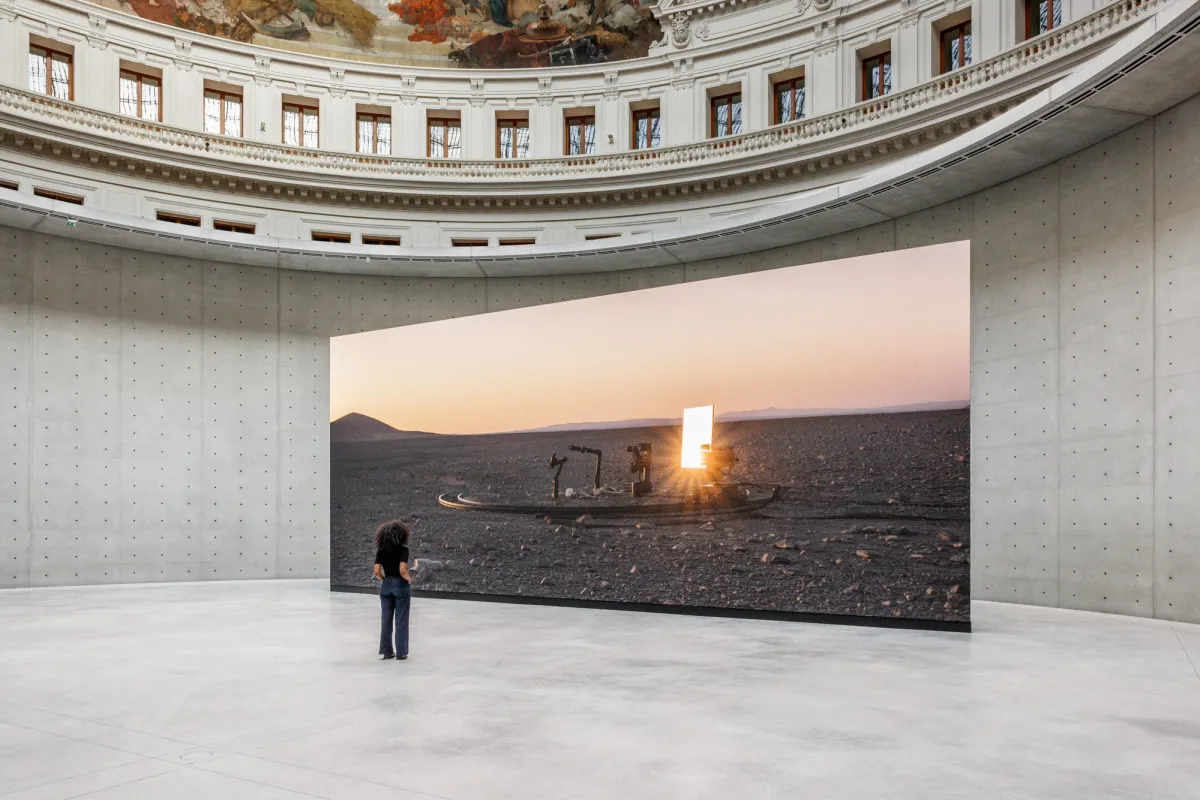
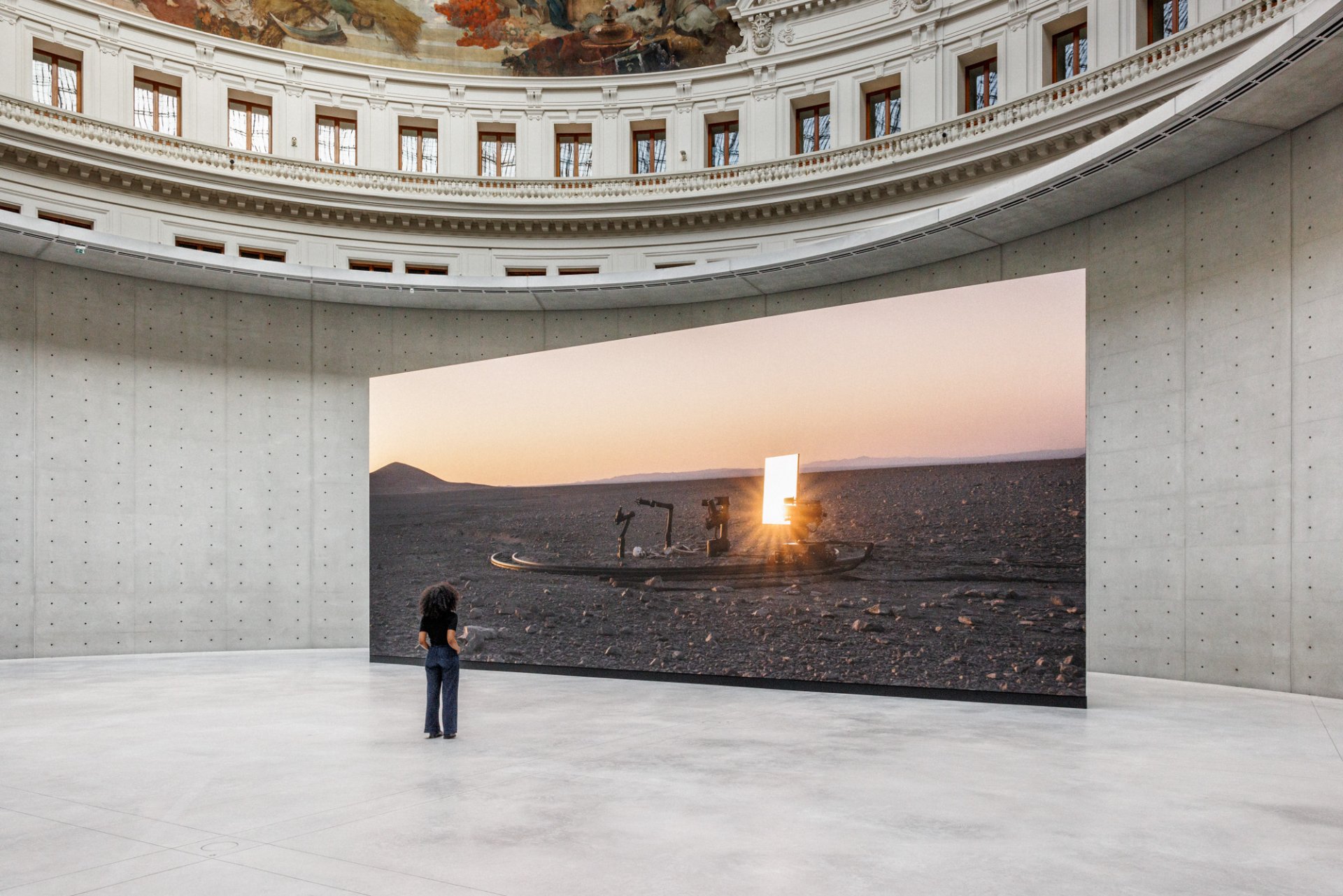
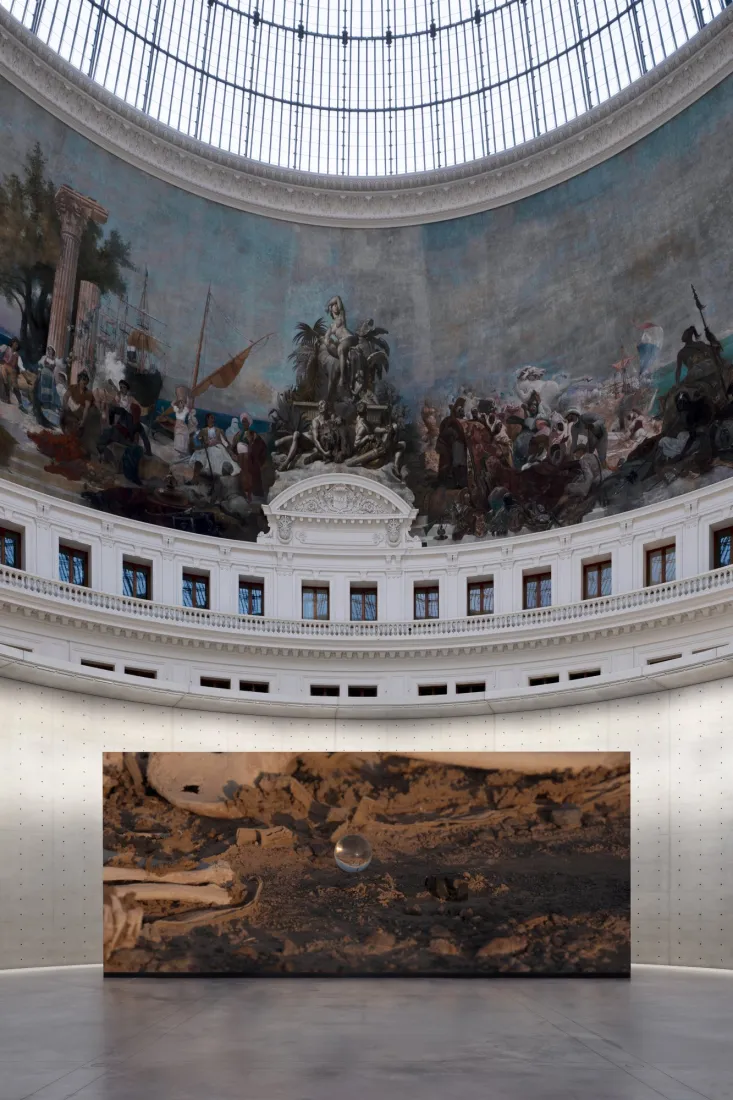
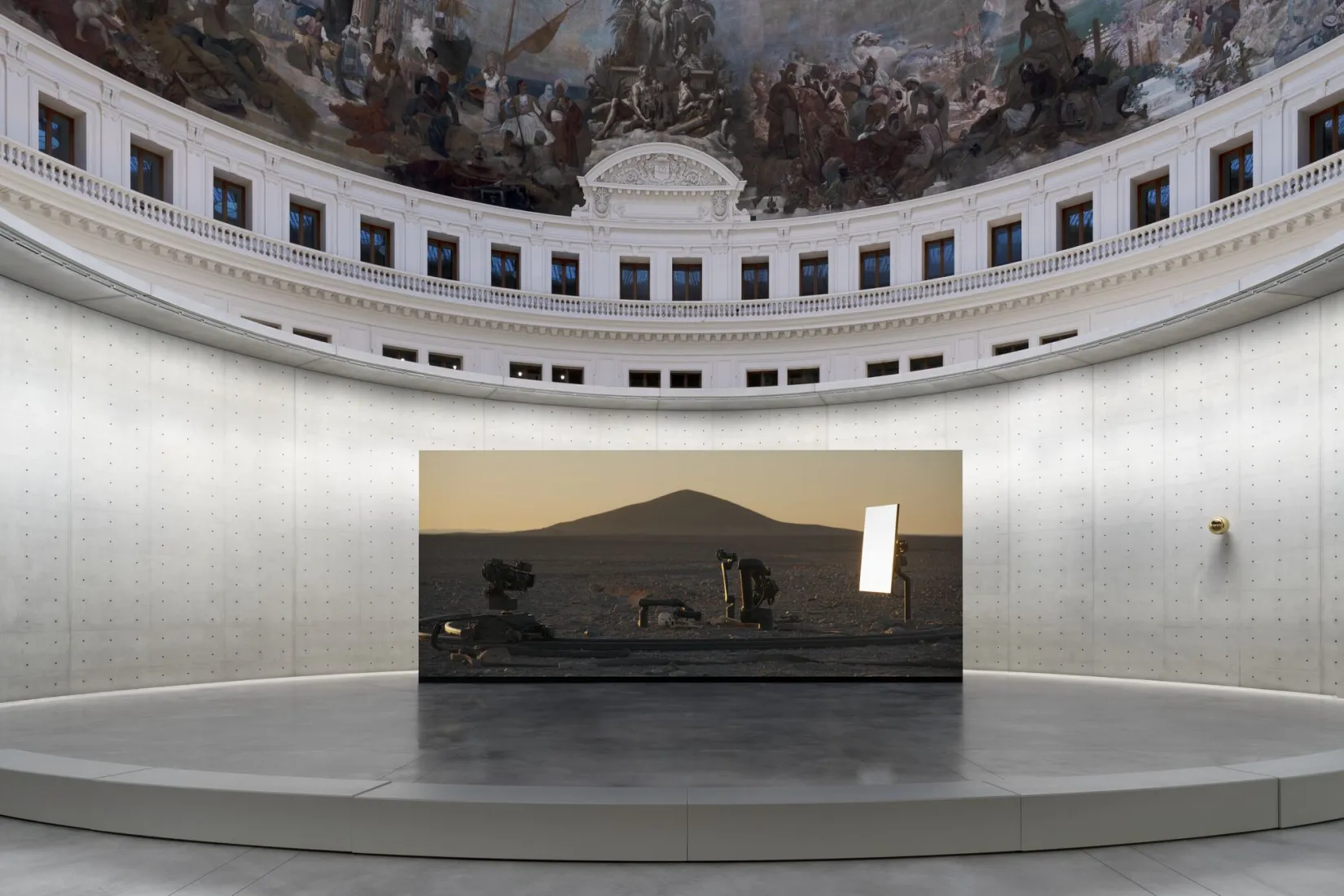
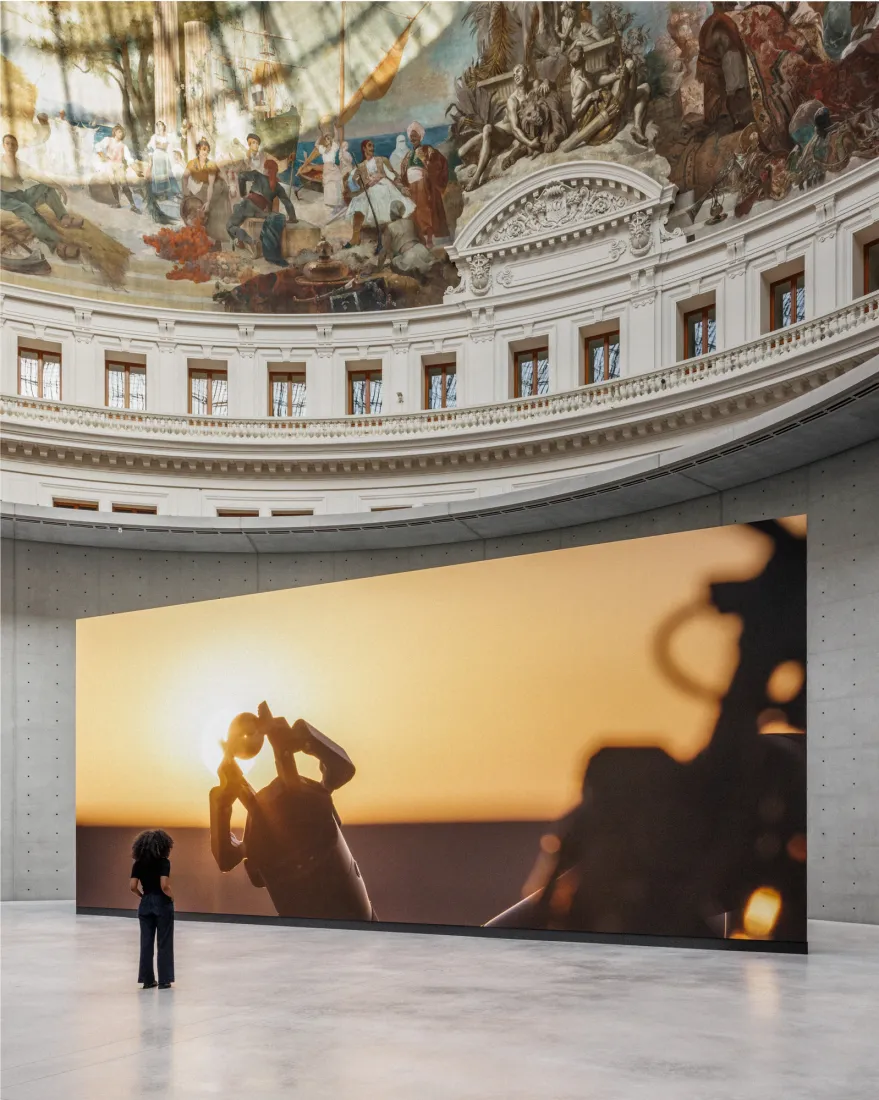
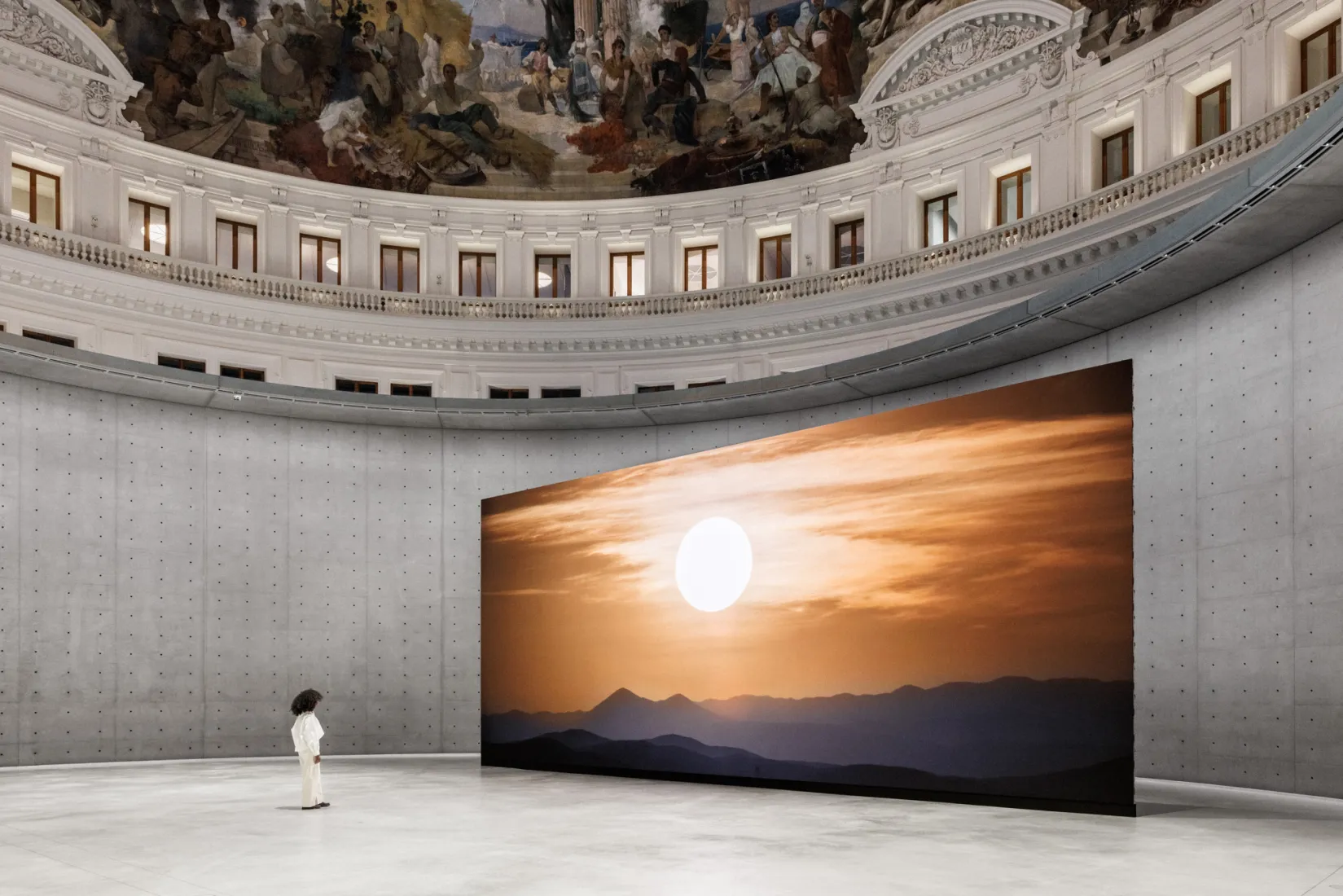
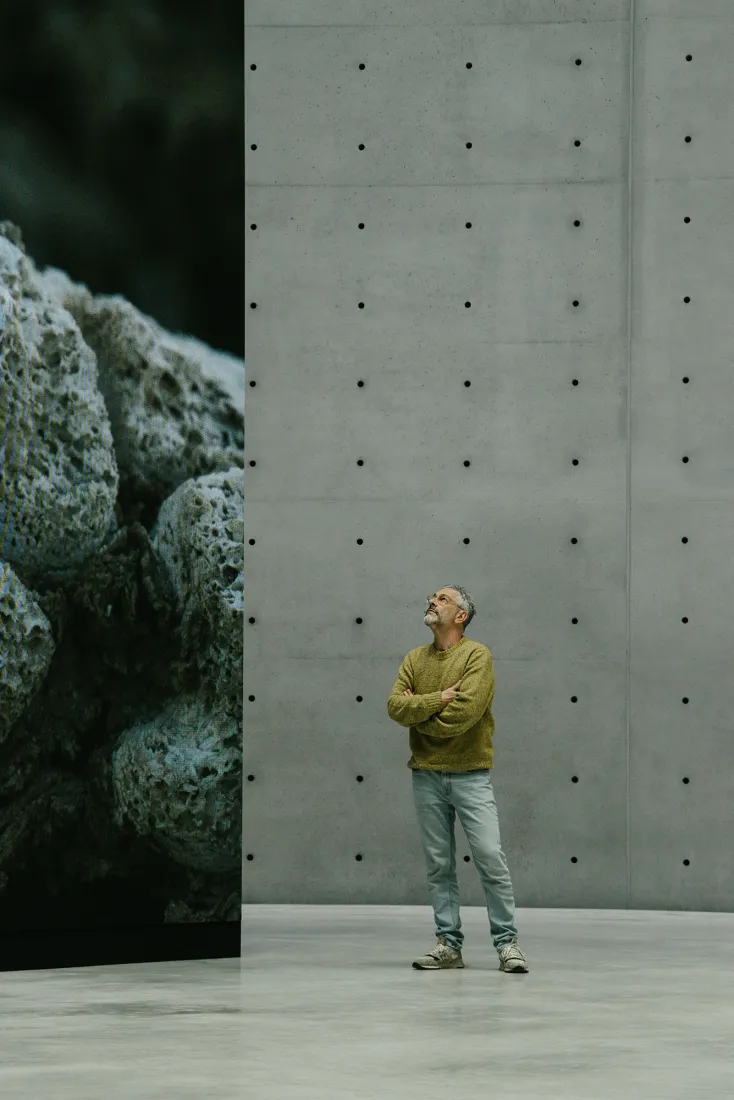
As part of the exhibition “Clair-obscur,” the film Camata (2024) by French artist Pierre Huyghe is is majestically featured in the very centre of the museum, inviting viewers to contemplate the place of humans in a world ruled by technology. It reenacts ad infinitum a hybridisation of life and death, reality and fiction, body and landscape, past, present and future, night and day, shadow and light, earth and sky, ritual and cosmos, and human and non-human.
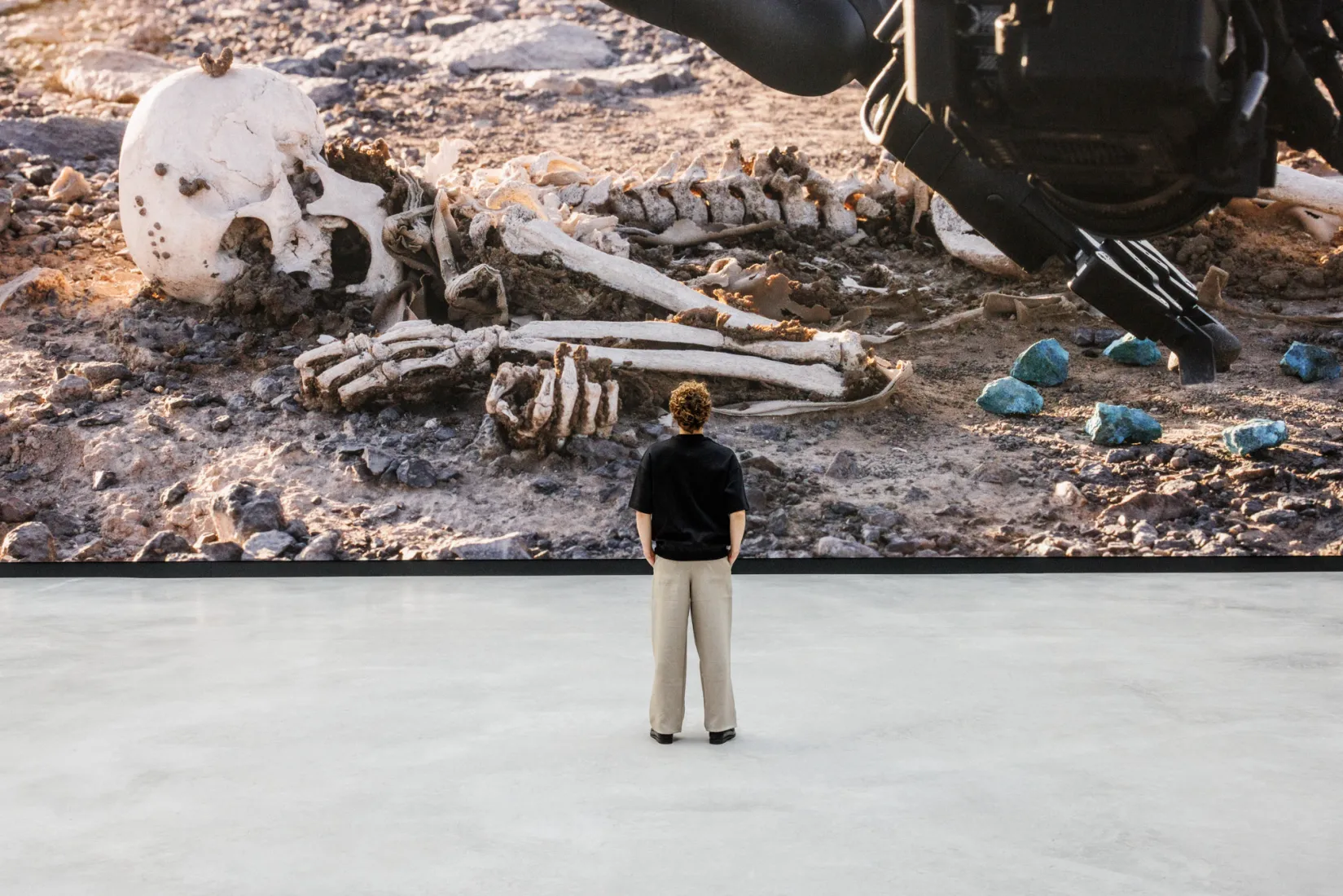
In the Rotunda, Camata portrays a landscape between day and night in which a strange, robotic ballet plays out. Orchestrated by machine-learning algorithms, the pace of the images is in perpetual transformation. A set of machines performs an unknown ritual involving an unburied human skeleton that was discovered in Chile’s Atacama Desert. Obsessed by the discovery of this unburied corpse lying between the ground and the infinity of the cosmos, Huyghe invented a ritual that is at once archaic and technological, in which mechanical arms powered by solar panels move around the skeleton in a choreography that is as slow and precise as an autopsy. They delicately handle glass balls and amulets, engaging in gestures of a metaphysical and funerary ceremony that asks us to meditate on humanity’s place in a changing world ruled by technology
Curated by: Emma Lavigne, general director and curator, Pinault Collection
“I came face to face with this body in 2015. The image came to exist before it was captured photographically. It was in a very particular place, in the world’s oldest, driest desert—the furthest from any form of life. NASA uses this place to test its instruments to detect life on exoplanets. The largest astronomical telescope and solar power facility in all of South American are located there. Amidst these instruments that focus on other stars, lay this skeleton on the rocky ground of the desert, blending into it, positioned as if it were someone sleeping next to a dried-up brook.
As I was thinking about an entity that could build and present itself in a film, the idea came to me for an operation, a set of actions that would unfold around this body. Around it are robotic arms emerging from the ground that initiate gestures. They assemble elements and objects into configurations, geometries, and symbols that surround or traverse this body, which has become a stage. Their actions produce sounds and music. This process repeats itself live over several days and nights, I hope over several years. A set of sensors, specifically cameras, records as a heliostat reflects the light or captures what is happening.
We instantly think of something resembling a funerary rite, a surgical operation, or an anatomical theatre. We can observe a new subjectivity emerge through this learning process, even the birth of a strange metaphysical transaction between these different realities. It is an enigmatic, symbolic exchange between the non-existent and the disappeared, a game that produces nothing, neither meaning, nor a result ”. — Pierre Huyghe
Excerpt of an interview with Anne Stenne published in the catalogue for the exhibition "Liminal", Punta della Dogana, Venice, 2024, Pinault Collection.
Pierre Huyghe seems to have taken philosopher Michel de Certeau’s philosophy "fiction is a means of capturing reality" to heart. Since the early 1990s, the artist has been reinventing ways of creating and questioning the many links between the work, the viewer and reality.
Although his works come in a variety of forms (videos, performances, objects and photographs), they focus on the same issues. The relationship to time and collective memory is sometimes explored through exhibitions, a means of expression in their own right that reveal the hidden side of creation. Huyghe conceives of his works as "event initiators". "They’re more about exposing someone to something than exhibiting something to someone,” he says.
Born in Paris in 1962, Huyghe studied at the Ecole Nationale Supérieure des Arts Décoratifs from 1982 to 1985. His work has been exhibited in many museums and at international events such as the Venice Biennale and the Documenta in Kassel. His Pinault Collection works were introduced at the 2006 show "Where Are We Going?" at the Palazzo Grassi in Venice.
Check our app!
The online app features audio content to give you a fresh look at the architecture (fr, en, it, de) and the artworks (fr, en). On your mobile.