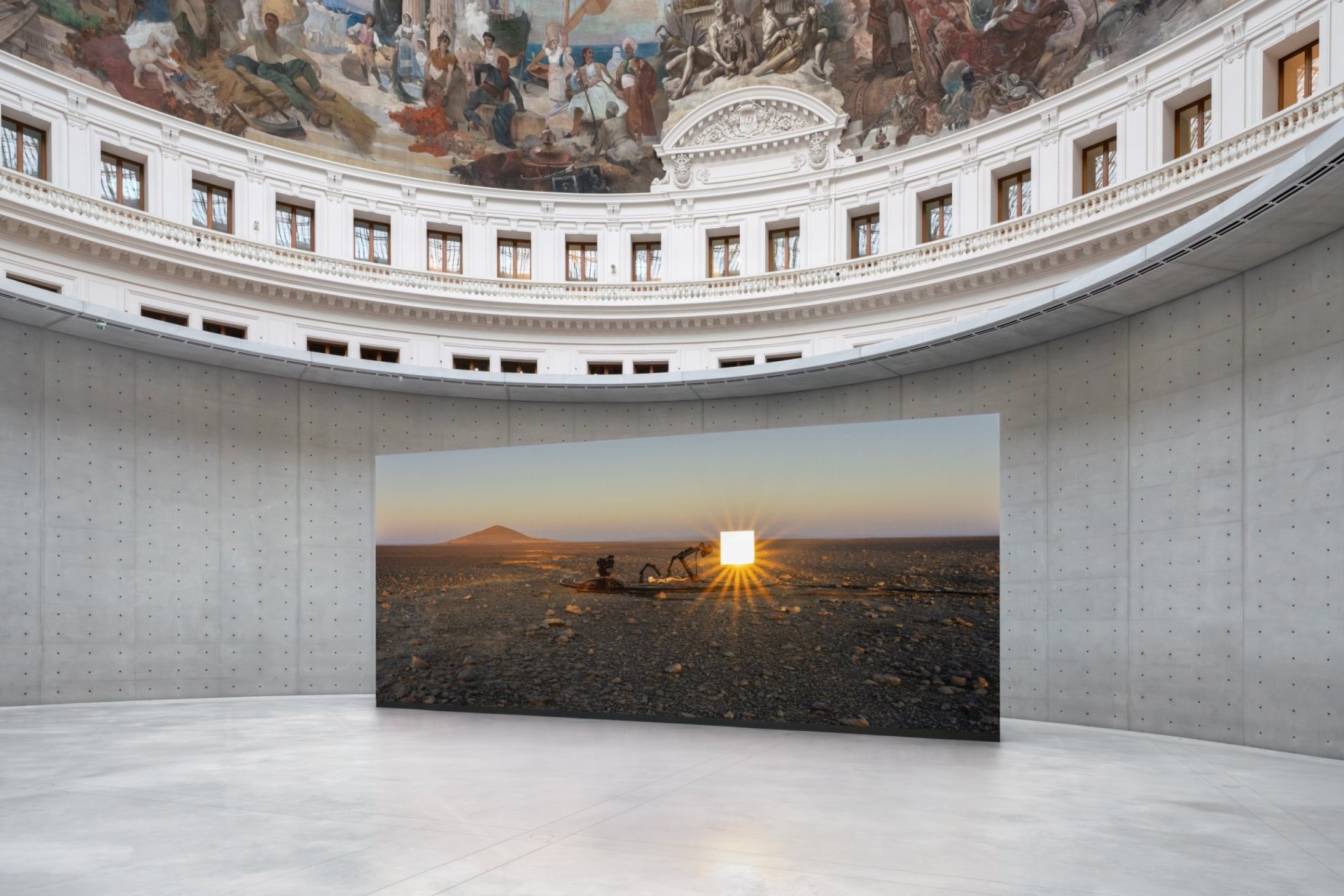
Pierre Huyghe, 2025 © Adrien Thibault / Pinault Collection
Interview

“What interests me is this indeterminate space, in which things appear without being intelligible”. — Pierre Huyghe

On the occasion of the screening of his film Camata (2024) in the middle of the Rotunda, Pierre Huyghe reflects on this enigmatic, meditative piece that is constantly recomposing itself.

Without a beginning or an end, Camata is a self-generated work of film. Why did you assign this degree of autonomy to the real-time editing of the images through the use of algorithms and sensors?

It’s more a question of phases whose sequencing has not been predetermined. This autonomy contributes to the formation of a subjectivity that is, however, not alive, and which emerges from a set of decisions taken by machines that learn, and which become manifest here. The film – and consequently the ritual – is self-generated and is always different. Observers participate in its changes by means of their presence (namely their thermal imprint and humidity levels), the timing of this interaction, and the information originating from the site of the capture.

Camata Pierre Huyghe

This piece depicts an archaic yet technological ritual which takes place around a skeleton that you discovered in Chile. Is it a way to pay homage to this abandoned body? Is it an act of meditation?

I came across this body in the Atacama Desert in 2015. The image existed in reality before being captured. The place is quite peculiar. This desert is home to the least amount of life in the world. We use it to test life detectors for exoplanets, and it also hosts gigantic astronomical telescopes. Amidst these instruments that focus on other planets, lay this skeleton, stretched out on this rocky ground, half-melted into the landscape. We witness a series of actions that evoke something like a funerary rite or a shamanic passage, an operation, or a form of learning. Robotic arms emerge from the ground and handle fragments of minerals which they assemble in configurations and geometries. The body becomes a scene, a landscape around which an activity unfolds. Perhaps this is the birth of a subjectivity that is itself not alive, which learns and acts around a lifeless body, the emergence of a symbolic transaction between what is no longer there and what does not yet exist.

“Amidst these instruments that focus on other planets, lay this skeleton, stretched out on this rocky ground, half-melted into the landscape.”

How do you use image and sound to connect the materiality of the objects being used – a mirror, robotic arms, pieces of metal, and more – to the cosmic immensity that extends across this desert horizon 

In this desert, everything acquires a cosmic scale. In Camata, the capture is a self-generating process that records the world as if it were data, without making any distinctions between its material configurations. The robotic arms, mineral fragments, piece of metal, and the heliostat mirror act as mediators between different scales of reality, forming a set of parallel interactions. There are no hidden points of view. The cameras and the machines are as much actors in this situation as the bones, the dust, the stones, the light, the sound, the sun, and the stars. The capture of this image is no longer human; it is raw data in which body, landscape, and the means of observation merge into one. The machines’ movements produce sounds and vibrations that, by means of pareidolia, make us believe we are hearing voices and murmurs. Together they compose a kind of language that is in the process of forming, and which consists of configurations, alignments, and rhythms.
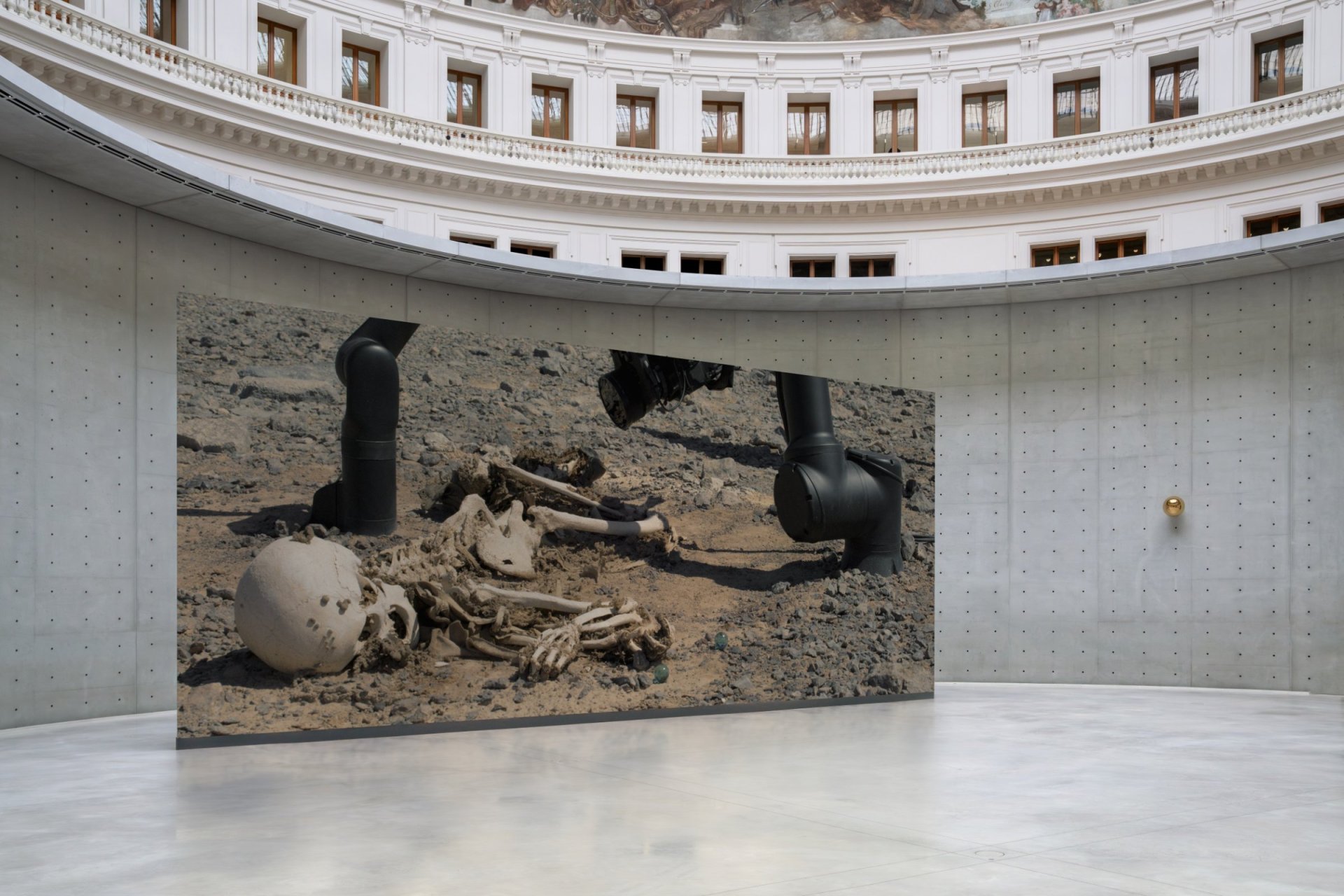
Camata Pierre Huyghe

The monumental screen installed within the Rotunda itself defines a kind of image, a frame bathed in the museum’s zenithal light. How does the experience of observing and discovering here differ from that at your exhibition Liminal at the Punta della Dogana in 2024?

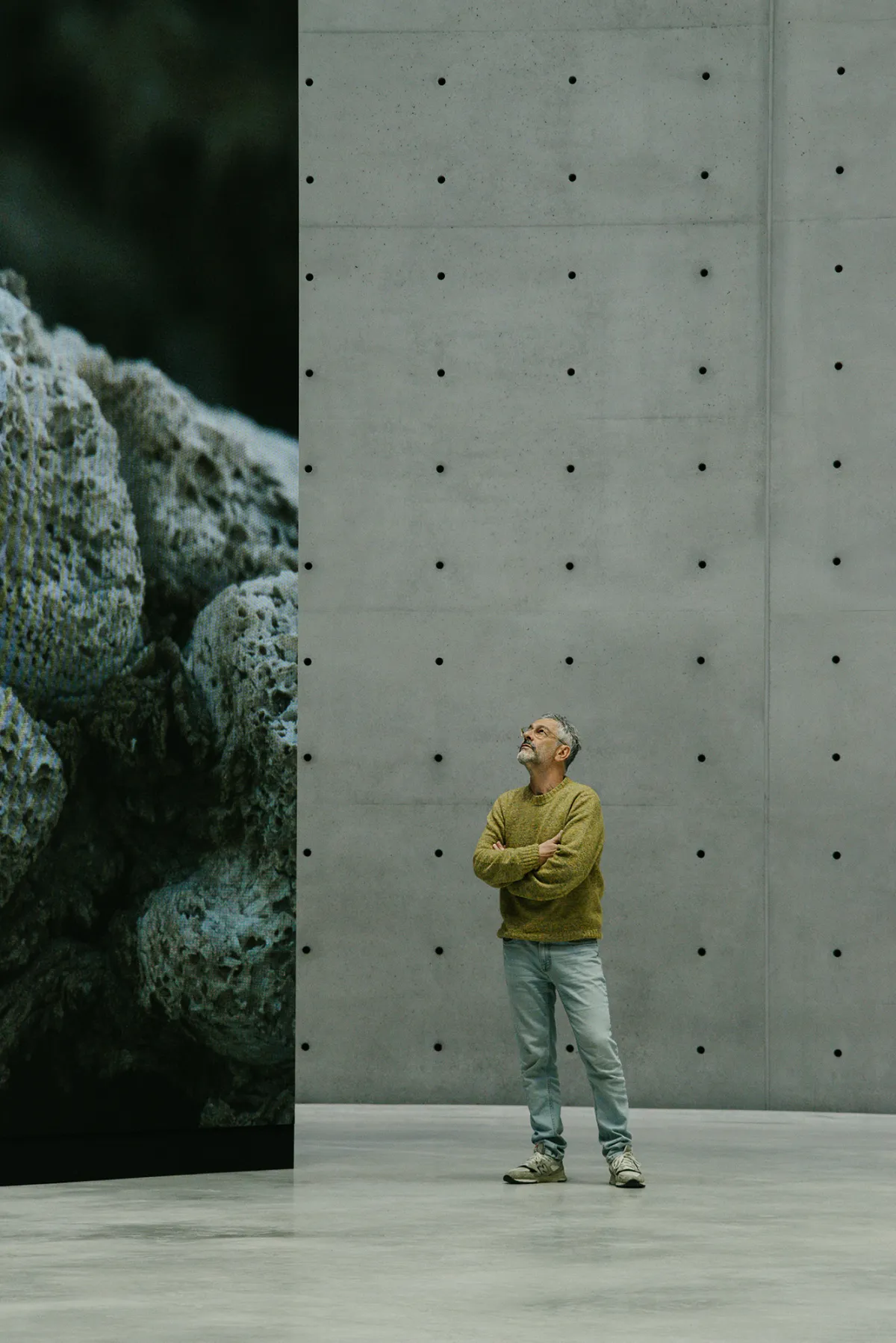
Each exhibition is the formation of a situation, and the place and timing of the interaction also affect its meaning and experience. At the Punta della Dogana, Camata  was exhibited along with other works in a very dark environment, where it emerged like an apparition. Here, in the Rotunda of the Bourse de Commerce, the zenithal light creates another relationship to the image, in which the experience becomes more vertical. With this body lying between the desert and the stars, we have a picture of the brief stirrings of human predation.

As in the title of the exhibition, “Clair-obscur”, which means chiaroscuro, literally “light and dark”, your work is replete with oxymorons: life and death, human and artificial, reality and fiction, day and night, and earth and sky. Do you see these parallels as interconnected or as existing in a state of tension with one another?

I do not see them as oppositions. They are instead thresholds, liminal zones between different levels of reality. Camata features a body without life and an entity without a body. Their convergence produces an ambiguous situation in which categories such as human, artificial, living, dead, animate, and inanimate cease to be opposites. The work resides in this space of indeterminacy and multiple possibilities. Chiaroscuro evokes this condition of an undefined zone where things appear without being intelligible. We sense something that eludes our comprehension, a non-thought, to which we become a perplexed witness. 

Pierre Huyghe, 2025 © Adrien Thibault / Pinault Collection

The piece Camata by Pierre Huyghe is being shown as part of the exhibition Clair-obscur until 22 May 2026 in the Rotunda of the Bourse de Commerce – Pinault Collection in Paris.

Search