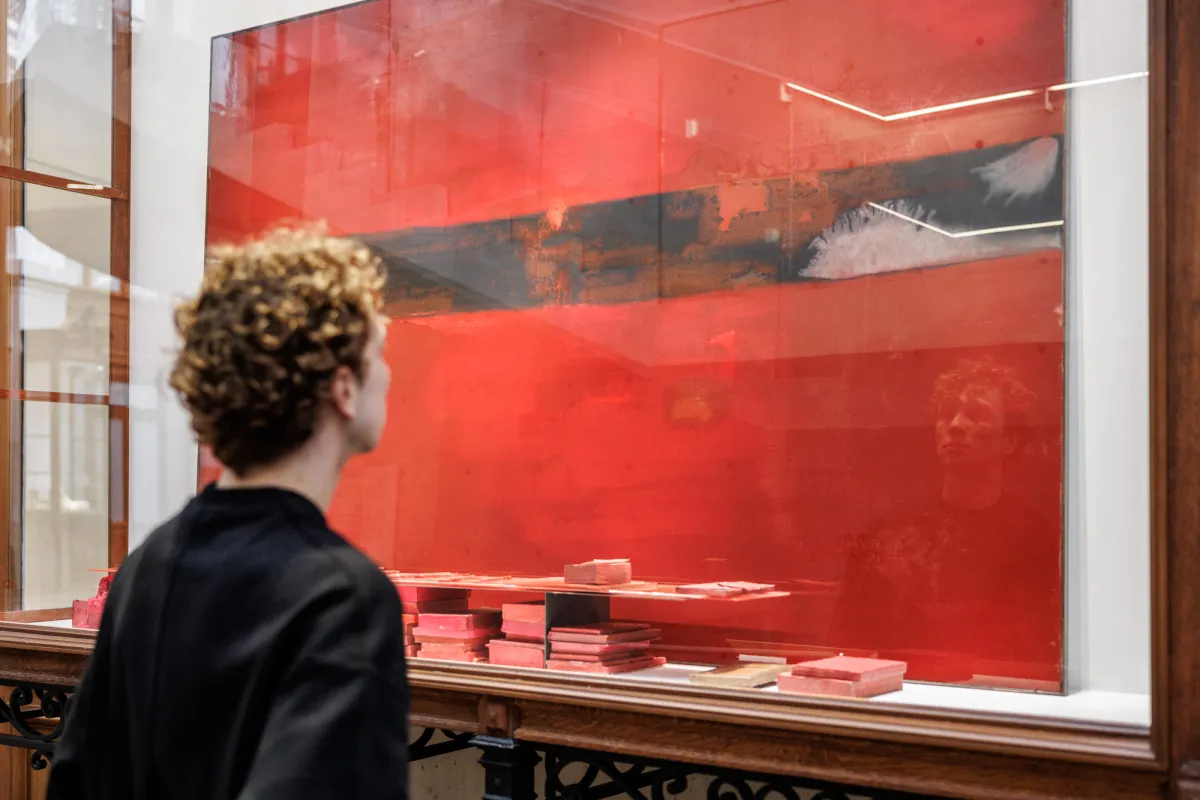
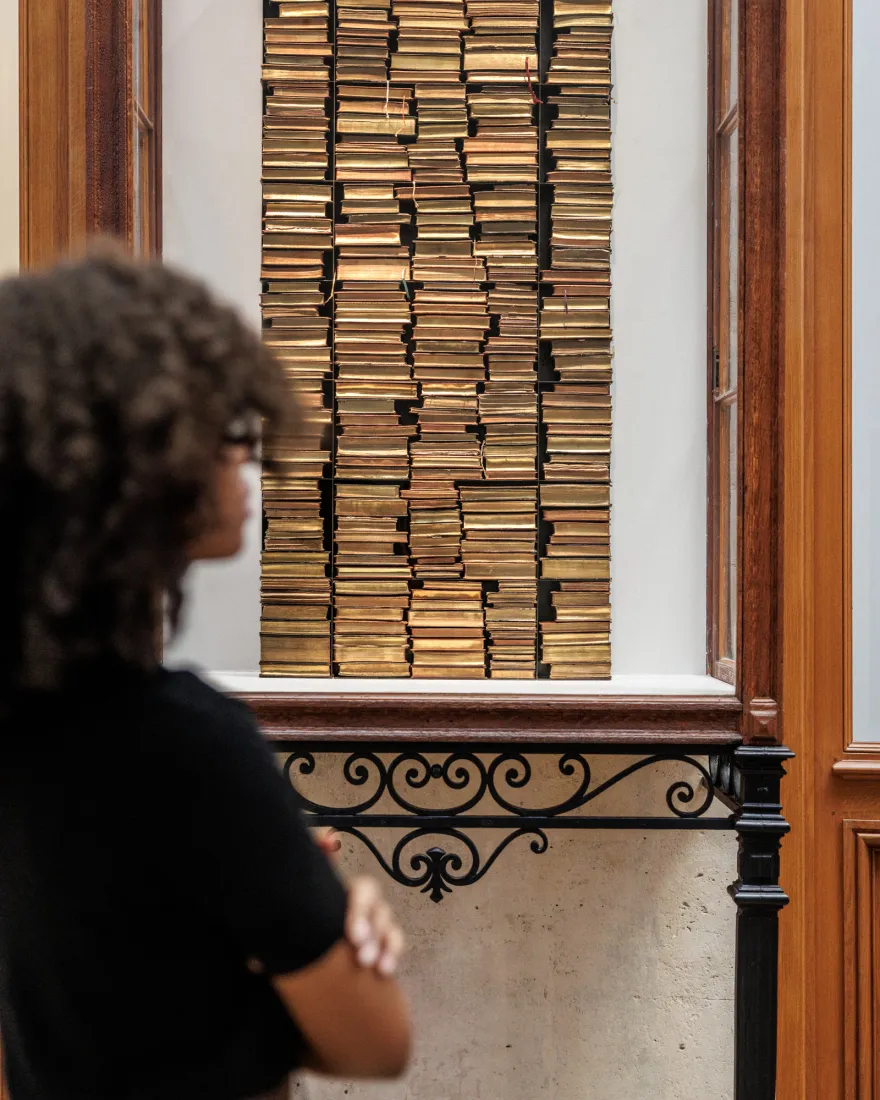
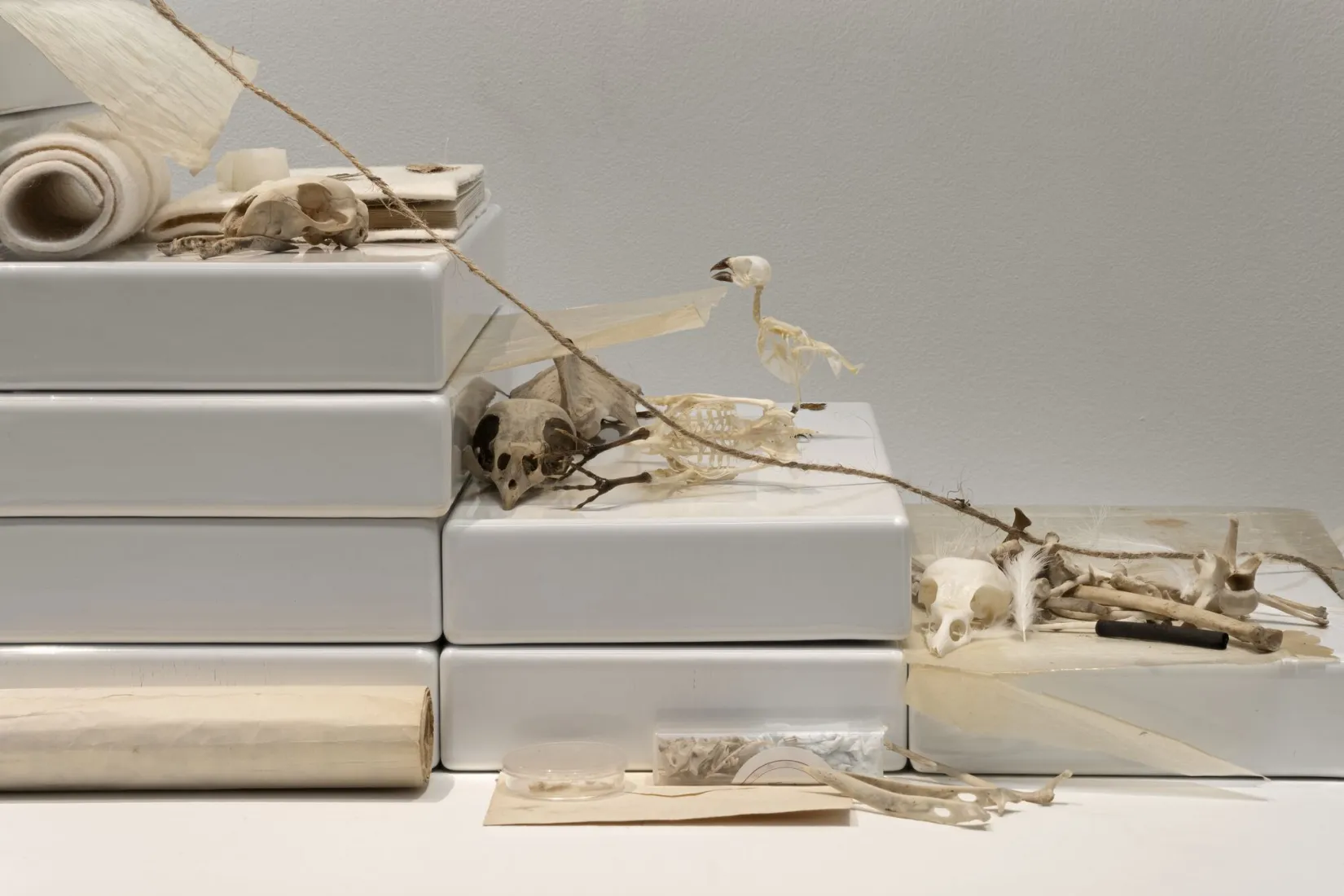
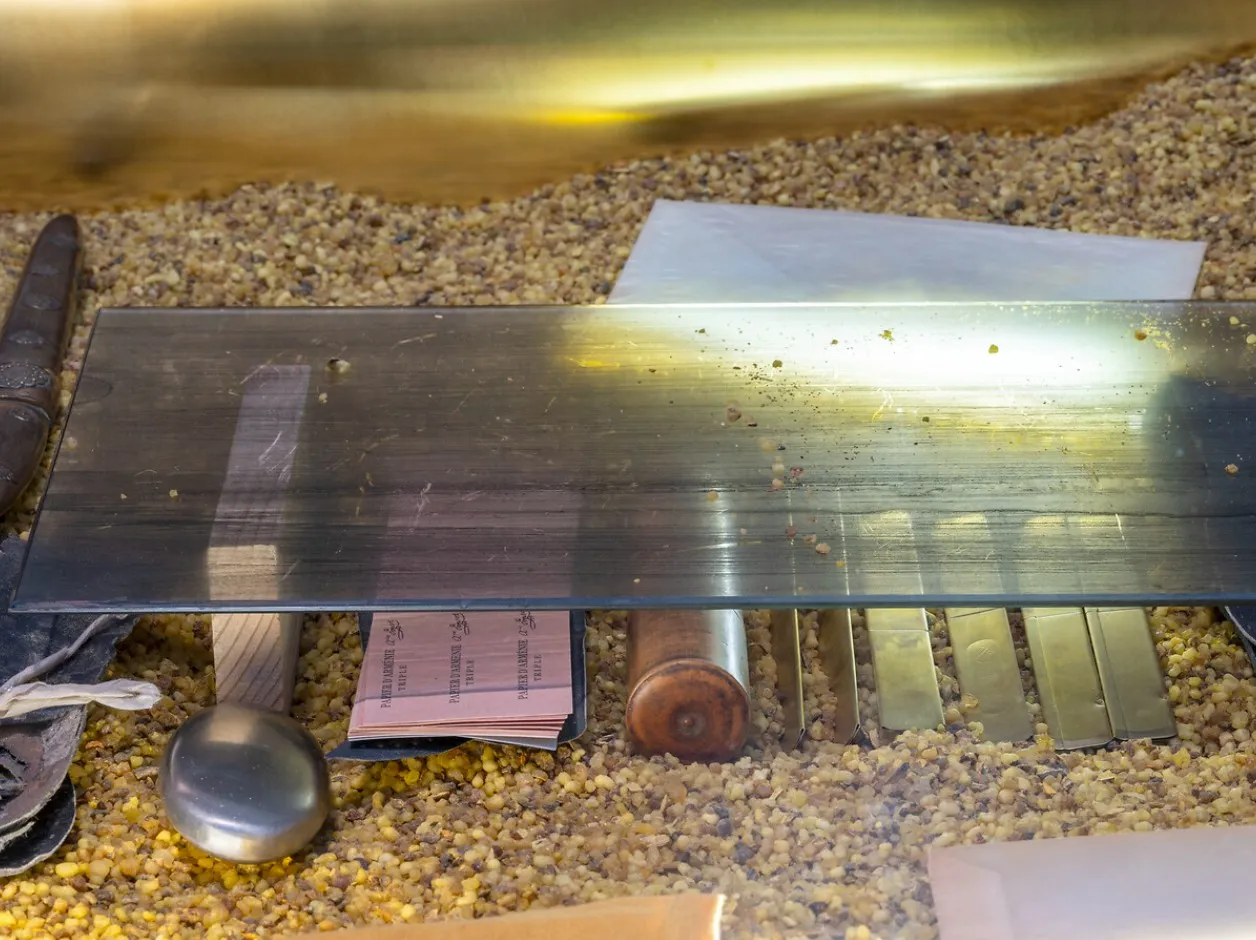
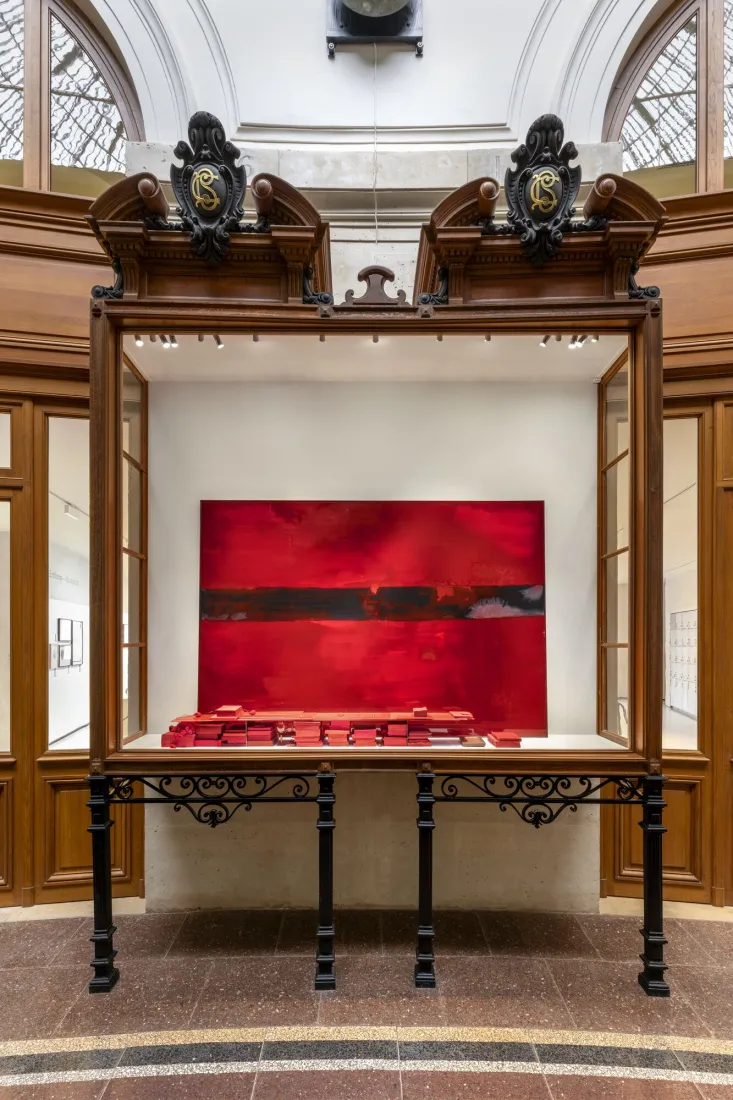
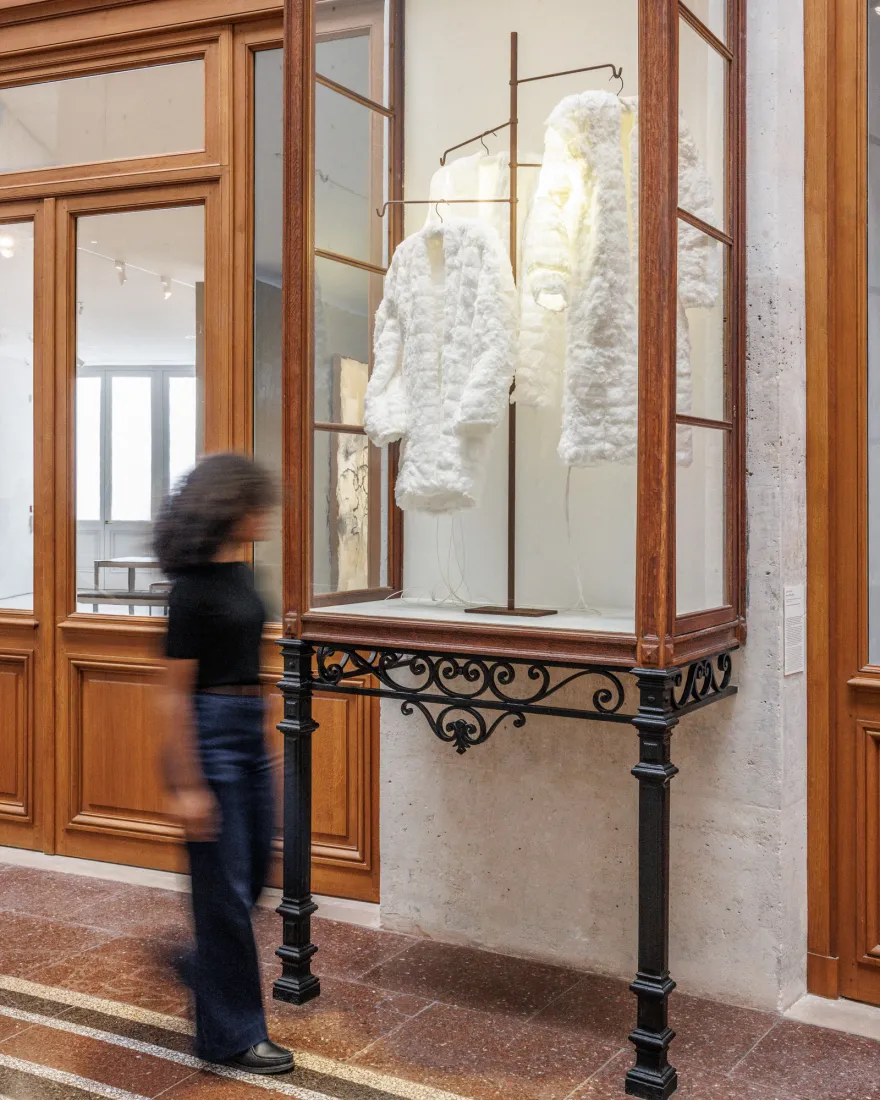
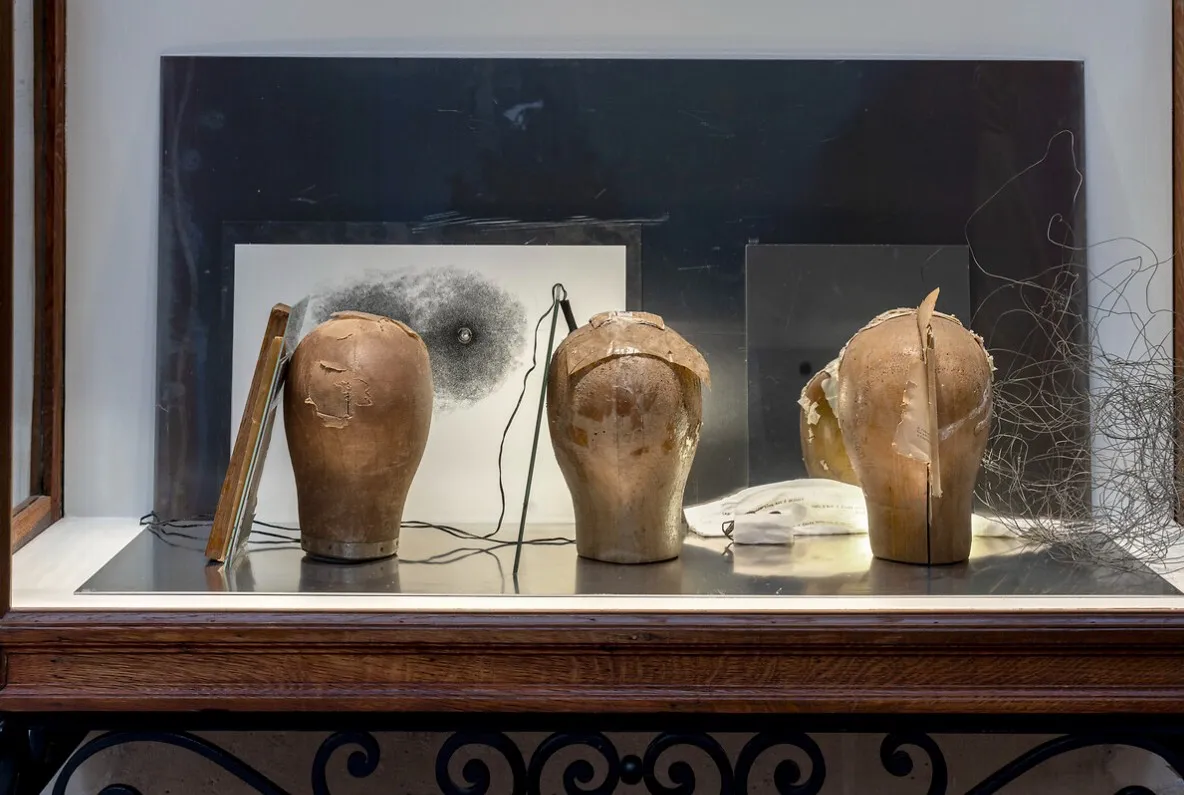
For the twenty-four display cases of the Passage, the circular walkway in the Bourse de Commerce, and in the Machine Room, Laura Lamiel (b. 1943, France) has envisioned and assembled a specific body of work in which colour and light play a key role. Between shadow areas and a selective lighting, she uses fragile, sensory forms composed of found objects and various types of materials. Organised according to a principle of tension, these pieces immerse visitors in a zone of flux, offering them a glimpse of something minuscule, fragile, and vulnerable. She also takes us on a metaphysical journey: that of an artist striving to give form to the invisible and the evanescent, to memory, emotions, and to inner states of being.
“‘They make a sound like wings, like leaves, like sand’, a title rich in rhythm and imagery, offers us a glimpse into Lamiel’s work in the display cases in the Bourse de Commerce. Taken from Waiting for Godot, Samuel Beckett’s landmark work of the Theatre of the Absurd, these words come from a conversation between the play’s two characters, Estragon and Vladimir, as they take turns trying to name, describe, even envision a sound or perhaps a noise that is barely audible or even non-existent. The scene suggests that the noise is both real and in the mind, sensory and poetic, like the visual landscape that Lamiel has created here. … Where Beckett used language to express its exhaustion, Lamiel uses materials to show the tensioning of objects and their occasional contradictions that she needs: ‘It takes me some time to get the distances between objects to talk to one another’. Her installations are based on this dialectic between exhaustion and renewal. Each piece is born from a dialogue between objects offset from one another, as fragments of the real world and traces of our lived experience. Lamiel seeks to create situations of presence, states of suspension and vacillation that the spectator no longer views from a distance, instead seeing them with a heightened awareness of the minuscule, of what trembles, and of details laden with significant evocative power. […] In the display cases, historical vestiges of the Grain Market, Lamiel has extended her research into ‘cells’, systems she began to form in the 1990s that prompt visitors to think about the exhibition space, the question of their own gaze, and the staging of the intimate. These open structures, often consisting of white partitions, sheets of glass, and one-way mirrors, evoke the museum device of the display case in an unsettling manner. […] Forms, materials, and colours recur from one display case to the next: children’s shoes, gloves, chairs, chalk dust, compressed fabrics, water-absorbent cotton coats, enamelled bricks, and a phrase typewritten onto a piece of cloth (‘there is nothing to be done; everything must be undone’). These recurrences elicit “the memory of the previous works’ to create a rhythmic, almost musical composition. What begins here finishes over there, like a continuous breath.
Another omnipresent component of Lamiel’s oeuvre is light itself. Fluorescent tubes reveal and conceal their accompanying objects. Some compositions that lie partially in shadow are traversed by a ray of light that delineates an opening. Light thus does more than illuminate objects. It structures the space, demarcates transitional zones, and generates a tension between presence and absence, surface and depth. In Lamiel’s installations, surfaces are illuminated and materials of all kinds are accentuated, driven by the artist’s desire to bring things into being that are ‘both light and shadow’. This reveals not only what is present, but what remains latent or held in reserve. The contrasts between light and shadow are also made manifest in the materials used by the artist, the succession of black paints and immaculately white cotton coats, and the gilded edges of missals stacked atop one another.
Lamiel composes suspended ‘landscapes’ in which our gaze alternates between reflection, transparency, and opacity. Light evokes time, wear, and memory. ‘Traces’ of the past coexist and converse with contemporary structures. Light brings these elements together within the same sensory field where differences are revealed and the minutest detail is as powerful as the whole that surrounds it. For Lamiel, light reveals inner spaces. It is a sculptural element in its own right that gives viewers a subtle glimpse into the artist’s vision. In the silence of the glass and the light, in the crumpling of the materials, there is something human that continues to rustle: a sound like wings, like leaves, like sand”. — Alexandra Bordes, Excerpts from the exhibition catalogue
Curated by: Alexandra Bordes, Project Manager for the Curatorial Mission
This installation is presented as part of the exhibition "Clair-obscur".