“I have a deep faith in human beings” — Saodat Ismailova
Saodat Ismailova is an artist originally from Central Asia who has created a dialogue between different eras. The films featured in "Clair-obscur" use light as a narrative thread that oscillates between luminosity and shadow to offer us a poetic vision of the sacred and of ancient myths.
The prophet Al-Muqanna is the leitmotif that runs through the two works screened on the museum’s lower level. Why is this historic figure so compelling to you?
These two works are inspired by Al-Muqanna, a historical figure whom people have learned about in Uzbekistan, my native country in Central Asia, both during the Soviet era and since independence. What first piqued my curiosity was that Al-Muqanna did not leave behind any written texts or tangible artifacts, yet he continues to be the subject of extensive interpretation and speculation. That he kept his face veiled also intrigues me deeply. What is hiding behind that veil? And there is another striking aspect that is practically a collective memory: legend has it that his face emitted a light so bright that it could blind anyone who looked at him. If this figure lingers in people’s memories and continues to resonate through all manner of political and historical upheavals, it is because he holds a particular significance. That is why I came to be fascinated with this figure.
Your works often exist in a state of tension, between personal and collective narratives, and between utopia and disaster. Is that ultimately your relationship to chiaroscuro?
My connection to chiaroscuro comes from Zoroastrianism, from the prophet Mazdak, a figure who greatly inspired Al-Muqanna. Mazdak was the first to draw a boundary between shadow and light, and this duality is present in my film. This worldview dwells on the opposition between good and evil, and between light and darkness at the heart of monotheistic religions. That is why I think these works form a dialogue with the exhibition Clair-obscur.
“If this figure lingers in people’s memories and continues to resonate through all manner of political and historical upheavals, it is because he holds a particular significance. That is why I came to be fascinated with this figure”.
Can you tell us about the genesis of these two films?
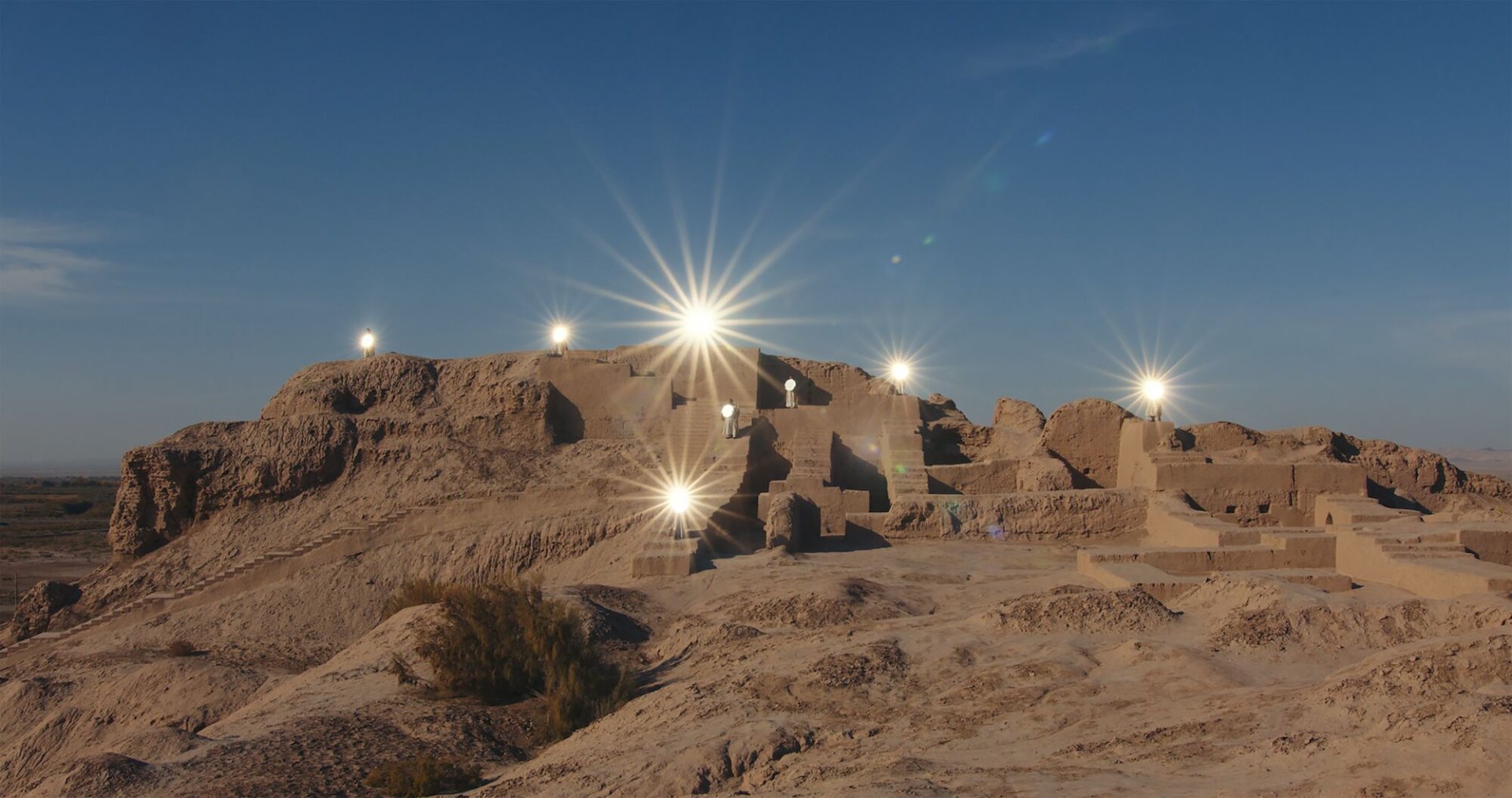
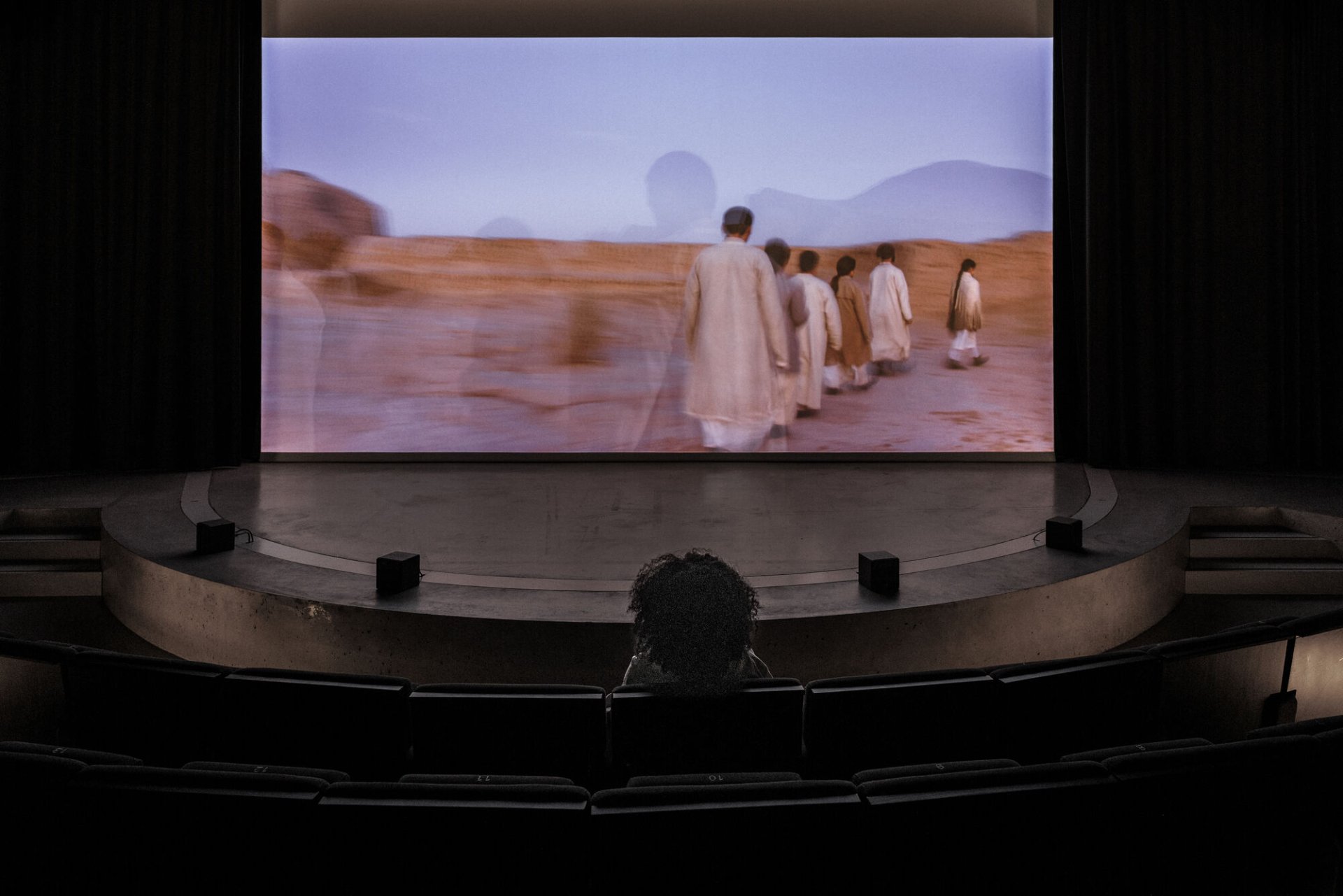
Melted into the Sun came to me as a title even before I made the film, some two years ago. At that point I wasn’t sure what form the project would take, but I did know that I wanted to make a film with that title. This idea arose from a glaring reality in Central Asia, especially in sedentary societies, where certain women have taken their lives through self-immolation, by throwing themselves into the fire. This act expresses a symbolic connection to the gods of fire and of the sun. I see a deeper impulse there tied to the presence of the sun and to the power of its light.
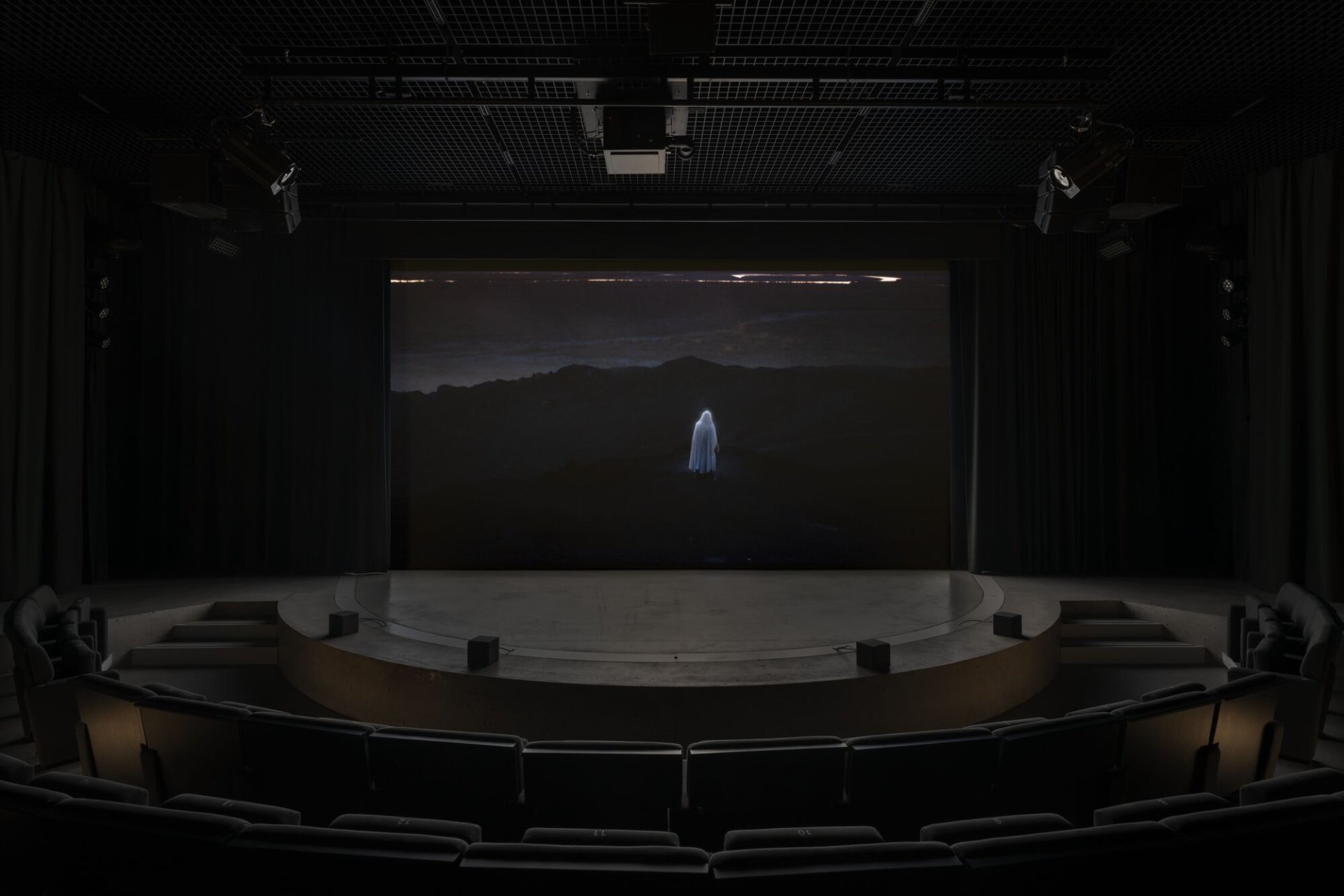
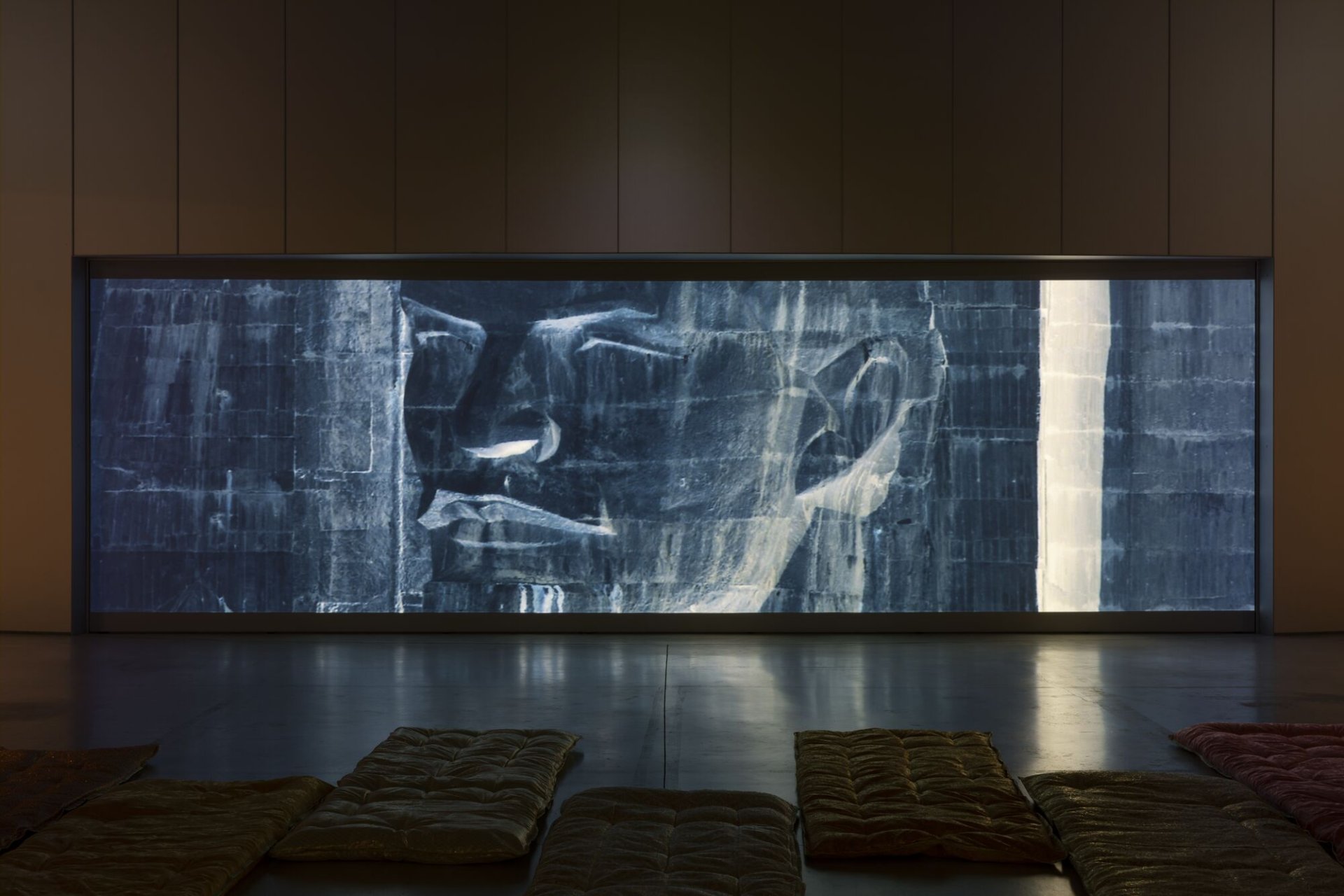
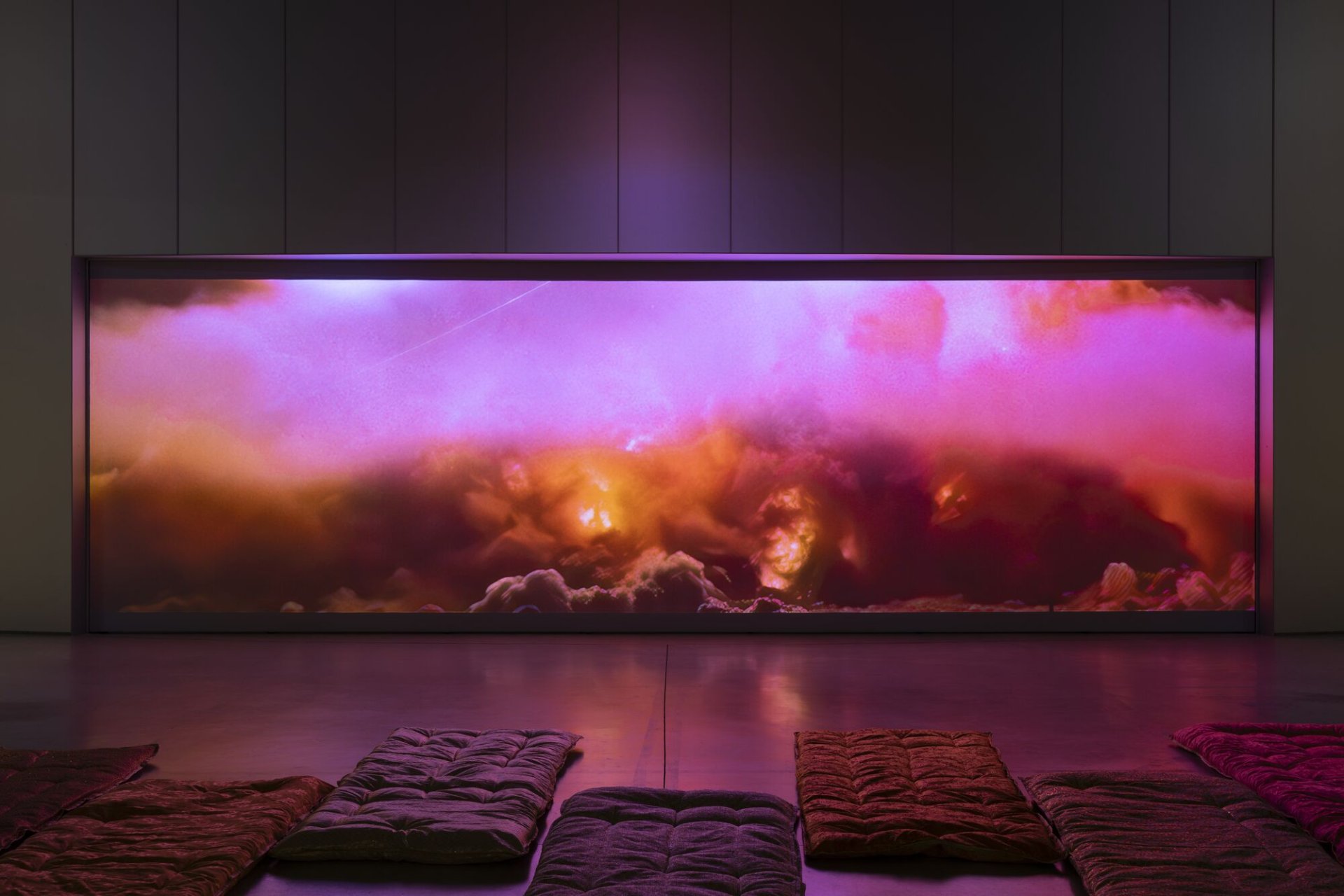
The museum decided to screen Melted into the Sun in the auditorium of the Bourse de Commerce. I was then asked to create a piece for the Foyer, a remarkable space whose shape evokes that of a crescent moon. I wanted to make something specifically for this space. It is a site-specific work that includes the traditional Central Asian mattresses called kurpacha. This object is an essential, omnipresent aspect of daily life, from birth to death. It has formed part of my artistic practice since 2022, especially since Documenta. The ones I am exhibiting here were specially designed for Melted into the Sun. Their silver and gold highlights reflect the light, in resonance with the character in the film, whose fingers and nails are alternately immersed in silver and then in gold. The installation thereby enters into a direct conversation with the filmed image.
What led to your interest in the nuclear testing that was conducted in Central Asia, and how does this topic inform your artistic thinking?
I became interested in the nuclear testing, and more specifically the legacy of the experiments conducted in Central Asia, mainly at the site of Semipalatinsk, in Kazakhstan. The number of detonations there is staggering. In fact, the level of radiation is supposedly higher than in Chernobyl, a reality that remains largely unknown, undoubtedly due to its distance from the West. Even though the site closed after the collapse of the Soviet Union, I believe it is important to tell people about it and to keep talking about it. So, I threw myself into researching this question and in relating it to the figure of Al-Muqanna, because if we look back at history and what we know about him, he aspired to establish a just society, but his ambitions never came to fruition. In a way, he became a prisoner of his own fears. I see a parallel between his journey and that of the nuclear tests, which embodies a nearly imperceptible shift from good to evil. It takes the smallest of missteps to fall into darkness, while in another context, these same steps could have produced something beneficial.
It is this very ambivalence that renders the figure of Al-Muqanna so fascinating: the capacity of a person to be animated by a form of light and then to cross over to the shadows, even dragging his faithful followers to destruction as he led them to commit suicide together. From this perspective, we can look at the nuclear tests as a kind of suicidal impulse, despite their underlying utopian vision of scientific progress and human development.
The film To the Throat of the Sun was conceived specifically for this exhibition. Can you tell us more about it? Light is omnipresent in this film. What meaning does it hold for you?
In To the Throat of the Sun, I wanted to push these thoughts further with a new kind of film. I had initially envisioned something very stripped down, almost abstract. But I was soon taken with the richness of the images I had already filmed, as well as my experiments with light in the Melted into the Sun, and this led me to develop the project further.
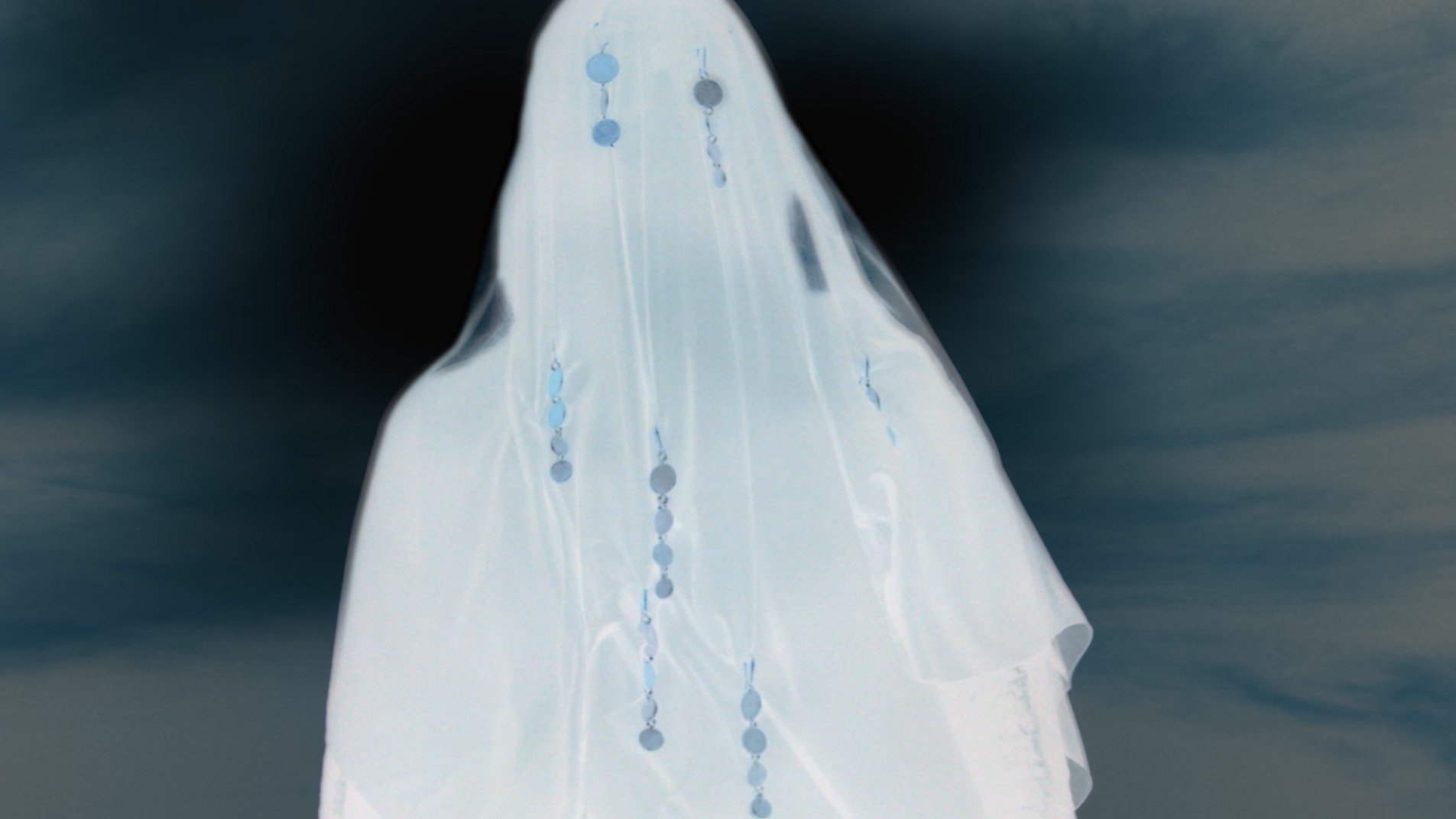
We can see the luminous mask I made in 2023 but which I had never included in the first film, as well as figures of the faithful who had remained invisible until then. I thought it would be relevant to reactivate these elements by incorporating them into this new piece for the Foyer.
For that matter, the film’s title comes from something one of the characters says: “I will take you to the throat of the sun”. This can be interpreted as a path to the light or as a journey toward a form of total destruction.
The characters are bleached out, reversed as in a negative. This decision alludes to the figure of Al-Muqanna, who was a dyer by profession, someone used to handling and controlling colours. I saw this piece as a way to extend certain ideas that I hadn’t managed to express fully in Melted into the Sun.
Sound plays a central role in your two films, be it voice, breathing, or a crackling fire. Why is it so important to you, and what experience are you trying to evoke with it?
By its very nature, an image immediately produces certain associations and sets our thoughts in motion. Sound opens up a whole other dimension. Stripped of any images, it becomes completely abstract. This sound space takes us past the limits of logical reasoning; it elicits sensations, memories, and feelings that elude a strictly rational reading of things. This is why it occupies such an essential place in my work. I don’t limit myself to just images when I edit; sound construction and visual construction advance hand in hand, and sound is as important as image in the construction of the narrative.
We are living through a dark period, characterised by constant transformations and a certain instability. This is the landscape in which the exhibition situates itself. How do your films resonate with such a context?
I have a deep faith in human beings. This was the fascination that guided the creation of Melted into the Sun, centred on this figure who shone brightly before he was defeated. Al-Muqanna could have founded a utopian society, like that of the Soviet Union. The starting point for these ideals is per se very beautiful, but it runs up against humanity’s fundamental desires and urges, which ultimately lead to its downfall.
As I was making this film, this thought formed part of a broader view of our capitalist reality. It also pondered our difficulty in envisioning a socialist system as anything other than a failure, the Soviet Union proving our sole example. We may nevertheless look at everything he tried to change. The real question then becomes knowing how such a system can engage with humanity’s fundamental desires and its survival instinct, especially at the collective level.
Despite everything, I have an abiding faith in humanity. This faith is in the present, the past, and the future. I sincerely believe that the world can progress, as long as there are visionaries who are capable of pointing it towards a better future.
Saodat Ismailova’s works are being shown until 24 August 2026 as part of the exhibition "Clair-obscur" at the Bourse de Commerce – Pinault Collection in Paris.