Prix Pierre Daix 2026
The 2026 Pierre Daix Prize was awarded to Arnauld Pierre on November 23, 2026, at the Bourse de Commerce by Emma Lavigne.
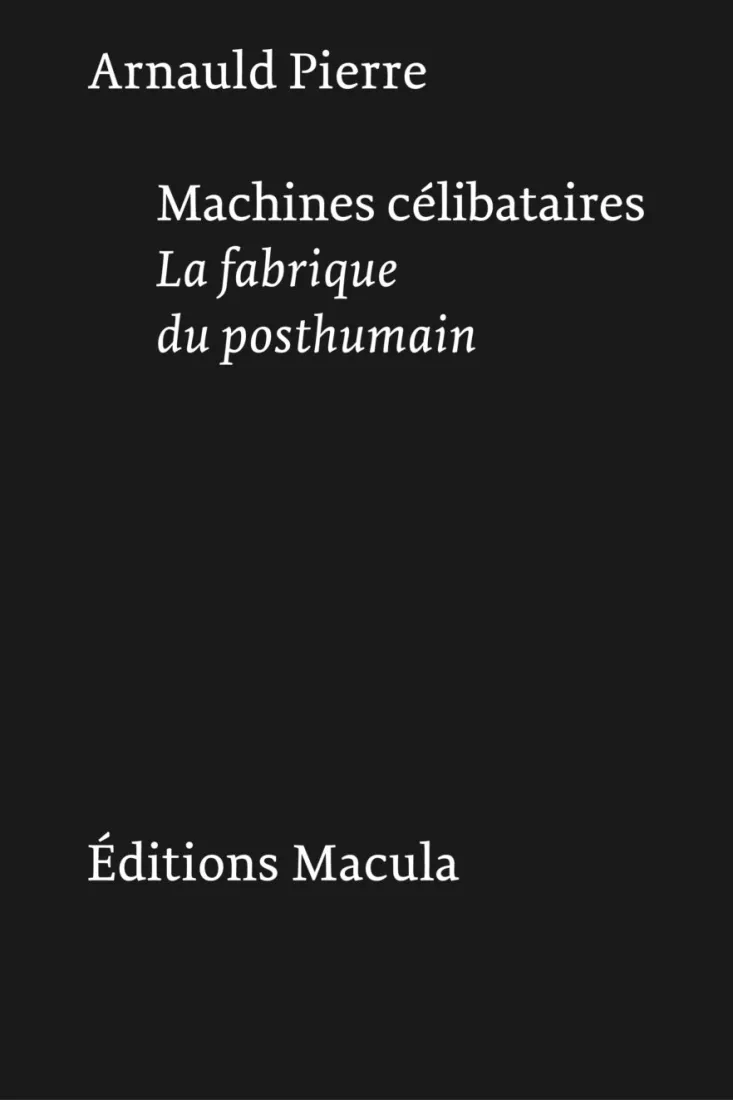
Pinault Collection is pleased to announce that the Prix Pierre Daix is awarded this year to Arnauld Pierre for his book Machines célibataires. La fabrique du posthumain, published in May 2026 by Éditions Macula as part of its “Patte d’oie” series.
The Prix Pierre Daix was created by François Pinault in 2015 in memory of his friend, French writer and art historian Pierre Daix, who died in 2014. A militant, resistant free spirit and major intellectual figure of his time, Pierre Daix was a specialist in twentieth-century art and author of several works that shed considerable light on the artistic movements in which he had taken an interest.Each year, the Prix Pierre Daix is awarded for a book on modern and contemporary art. On this its tenth anniversary, the prize was increased to €15,000.
The jury, which is composed of ten figures from the world of art and academia, has awarded the prize for the book Machines célibataires. La fabrique du posthumain by Arnauld Pierre. Already noted in 2023 for his book on moiré, this author, a specialist in the art of the 1960s and 1970s has focused here on the technological superhuman in art and visual culture, a theme that resonates directly with the pervasiveness of artificial intelligence in our present. He has compiled a kind of archaeology that goes from artist to artist, starting with Duchamp’s The Bride as the archetype of the Virgin Mother. His particularly ambitious and exacting approach looks at both modern and contemporary art. Illustrated with a remarkable visual and documentary apparatus, and nourished with literary, anthropological, cinematographic, and advertising references, this work deconstructs the myths of the posthuman through an erudite line of thinking and a powerful personal vision. Stimulating and accessible to a broad readership, it fully exemplifies the spirit of the Prix Pierre Daix through its able combination of intellectual rigour, reading pleasure, and social relevance.
L’ouvrage
Marcel Duchamp’s Bachelor Machines quickly broke free from their author to become a modern myth that blends art, sexuality, and technology. Associated with sterility and the refusal to procreate, they nevertheless do not rule out other forms of reproduction through fantasies of autogenesis and artificial procreation, in which science and technology become able to create superior beings and establish a world unblemished by any creation. An entire vision of filiation surrounds the Bachelor Machines, as shown by the large family of children born without a mother to mechanical parents that arose in twentieth century avant-garde movements, from Futurism to Dadaism, Surrealism, and Pop Art, leading up to the interest in the post-human in contemporary art.
At the intersection of the history of art and of ideas, and of the “scientific-marvellous” and science fiction, Arnauld Pierre dissects the origin myths of a humanity hybridised with its machines and examines, through its artistic manifestations, the advent of a technological Übermensch, an augmented, amplified post-human that takes pride in having been fabricated rather than engendered. In this richly illustrated work, which features almost 280 images, the author delves into the mechanisms underlying this recurrent desire to be better than human, which manifests itself par excellence in what is now termed transhumanism.
Founded in 1980, Éditions Macula specialises in art historical research, publishing classic works in this field as well as the work of contemporary French and international scholars. For the last several years, Macula has been directed by Véronique Yersin, who, together with the directors of this series, have expanded the catalogue to include literature, photography, coffee table books, and cinema. Macula assigns great importance to the critical apparatuses that accompany texts, and to the quality of the design and printing of their books.
Biography of Arnauld Pierre
Arnauld Pierre (b. 1967) is Professor of Art History at the Sorbonne and a research fellow at the Centre André-Chastel. His doctoral dissertation concerned the work of American sculptor Alexander Calder. He is the Vice-President of the Picabia Committee, which, from 2014 to 2022, published the four volumes of the artist’s catalogue raisonné, all of which he contributed to. He has also written an essay on this artist, titled Francis Picabia. La peinture sans aura, published in 2002 by Gallimard.
A specialist in abstraction, the scientific history and world view of avant-garde movements and their repercussions on contemporary art, he has published several works on this subject, including L’Abstraction with Pascal Rousseau (Citadelles & Mazenod, 2021); Maternités cosmiques. La recherche des origines, de Kupka à Kubrick (Hazan, 2010); Futur antérieur. Art contemporain et rétrocipation, (M19, 2012); and Magic Moirés. Gerald Oster et l’art des moirages (Macula, 2022). A member since 2001 of the editorial board of Cahiers du Musée national d’art moderne, where he has published many texts, he also edited, together with Pierre Denan and Michel Gauthier, 20/27. Revue de textes critiques sur l’art (2006-2011).
Arnauld Pierre has also worked extensively on Op art and Kinetic art, including texts and exhibitions such as L’Œil-moteur. Art optique et cinétique. 1950-1975 (Museum of Modern and Contemporary Art, Strasbourg, 2005), as well as the retros-pectives Nicolas Schöffer (Museum of Modern Art, Villeneuve-d’Ascq, 2018) and Vasarely. Le partage des formes (with Michel Gauthier, Centre Pompidou, 2019). He is currently working on the imaginary worlds of cyborgs and posthumans, as testified to by his latest book, Machines célibataires. La fabrique du posthumain (Macula, 2026).
Interview with the author
How would you define this notion of “posthumanity”, which you have related to the idea of “fabrication” in the title of your book?
The posthuman is the desired horizon – even fervently so – that many have set for humanity, from technologists to thinkers, art critics, and perhaps even some artists. The idea is that this will resolve all the conflicts inherent to the human condition and all the existential perils caused by our destructive activities. Posthumanism advocates for an ascensional fusion with machines, or even a regressive merging with animals, plants, and the earth. It is always an issue of finding a way out for a humanity that has cornered itself through its own mistakes. I myself have always been interested in the first approach, which involves the technological transhuman and the cyborg. I have tried to show that the fascination for the cyborg state, which began to peak in at least the 1990s, is an ideological construct and fabrication that dates back to the history of avant-garde movements and their fantasy-laden view of information from the industrial era.
You use Marcel Duchamp’s Bachelor Machines as your starting point, which form the lower part of The Large Glass (1923). How does this iconic work in art history address correspondences between creation, sexuality, and technology?
I began this history not just with Duchamp, but also with the interpretation that Michel Carrouges, an author close to André Breton and to Surrealism, gave to the Duchampian trope of bachelor machines and The Bride Stripped Bare by Her Bachelors, Even, also known as The Large Glass. Carrouges considered this work as a totem of modern times, in the anthropological sense of the term: as a structure that explains the mythical ascendancy of humanity, in which our natural Great Ancestors are replaced by mechanical entities because, in the world that humanity has fashioned for itself, it is these machines that dominate humanity’s mental and cultural representations. From that, the bachelor mythology is – with a considerable dose of irony – recombined with sexuality and technology to describe the advent of a superhumanity engendered by its own machines, of which Duchamp’s Bride is the primordial Virgin Mother.
The book’s visual apparatus draws on a broad range of disciplines, from visual arts to cinema and literature. How did you source these documents, and how do they serve the structure of your research?
My explorations of this mythology come from materials accumulated over years of readings and observations of art and visual culture in fields that have interested me, at first without my having a precise vision of things. Over time, enough revelations followed on one another that I was finally able to make sense of some of these longstanding obsessions. This includes Picabia’s series titled Girl Born without a Mother, and more recently, the way that this bachelor mythology is also clearly reflected in the narrative and visual structure of films like Alex Garland’s Ex-Machina (2014). And in drawing on a constantly increasing range of materials, the interpretation I developed became more and more systematically applicable, which proved its relevance. The connections became easier to make, the lines of descent became more obvious, and the common thread grew ever more distinct, from Futurism to Dadaism, Surrealism, Pop Art and on to contemporary art.
What was the experience of researching and writing this book like?
It was indeed an increasingly fluid immersion in a subject whose wealth I could not even conceive of at the outset. Writing organised and revealed a meaning that became more and more obvious.
How do you think this “transhumanist” vision resonates with our era?
The moment in time we are living through is singularly open to the promises of the transhumanist sphere, which vows that it will produce a technological Übermensch, an augmented, amplified posthuman who has been regenerated and rendered fully adaptable to the industrial, capitalist matrix that gives rise to it. So, exploring the myth of these bachelor machines involves, among other things, constructing an archaeology of this transhumanist transcendence and endowing oneself with the means to examine it with the necessary critical and political distance.
Members of the Prix Pierre Daix jury
The jury for the Prix Pierre Daix and the Pierre Daix Bursary is chaired by Emma Lavigne, General Director and Chief Curator of the Pinault Collection.
— Laure Adler, Journalist and author
— Jean-Louis Andral, Art historian and critic, Director of the Musée Picasso d’Antibes
— Martin Bethenod, Director of Cnap and Chairman of the Art Criticism Archives
— Nathalie Bondil, Art historian, Director of the new department of the museum and exhibitions at the Institut du Monde Arabe
— Jean-Pierre Criqui, Curator of the contemporary collections, National Museum of Modern Art / Centre Pompidou, editor-in-chief of the Cahiers du Musée national d’art moderne
— Cécile Debray, Art historian, Director of the Musée Picasso, Paris
— Donatien Grau, Historian of French art and literature, critic, and writer
— Christophe Ono-dit-Biot, Adjunct Editorial Director of the weekly magazine Le Point, writer
— Bruno Racine, Director of Palazzo Grassi—Punta della Dogana, writer
— Pascal Rousseau, Historian of modern and contemporary art, recipient of the Prix Pierre Daix in 202020