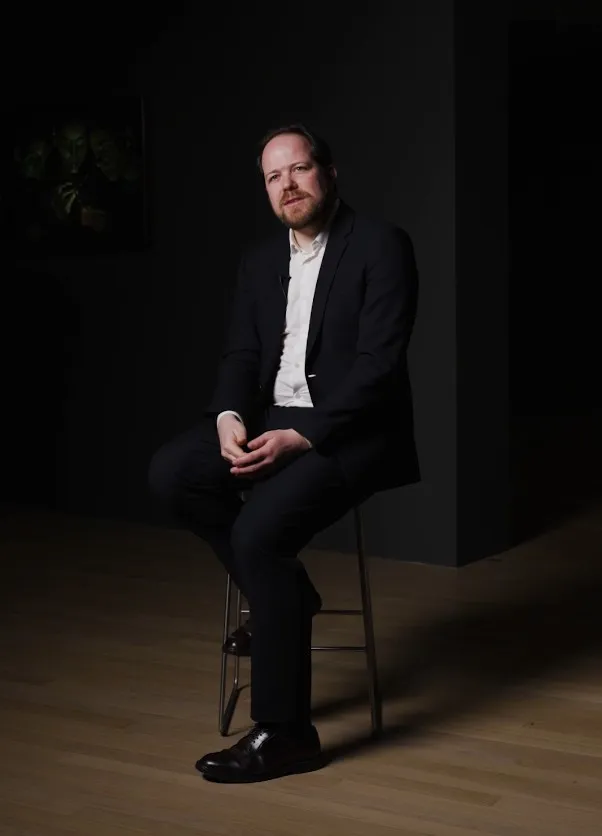
“Victor Man explores the depths of the human psyche” — Jean-Marie Gallais
The Bourse de Commerce is currently exhibiting ten paintings by Victor Man, a unique artist whose work captivates for its intensity and strangeness. Let's take a closer look, together with Jean-Marie Gallais, curator of the exhibition.
So many visitors are discovering Victor Man’s work for the first time. How would you describe it?
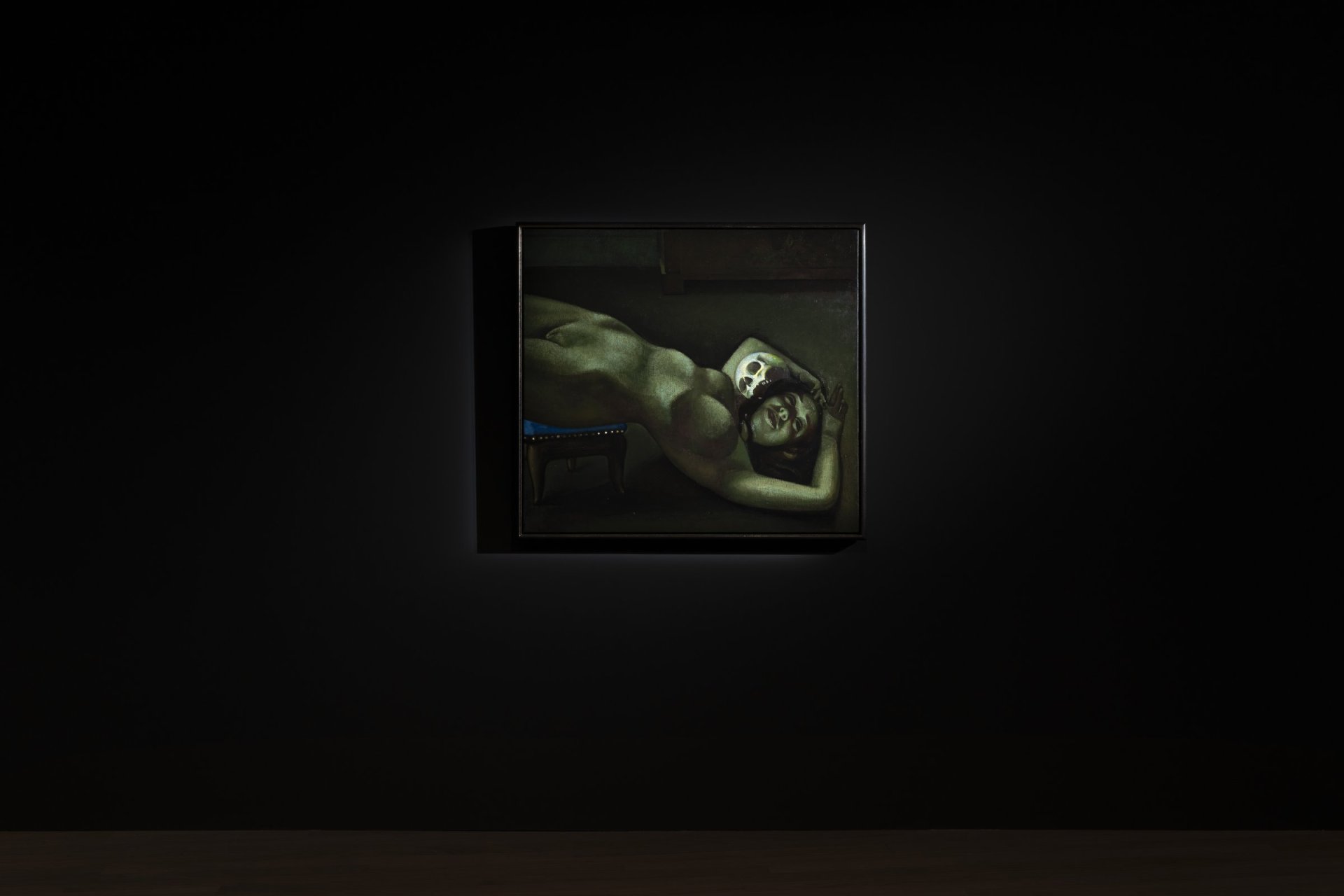
People often talk about the “enigma” of Victor Man because he is an unusual painter who produces few works, and because his subjects remain thoroughly mysterious. Man can be considered the contemporary painter of chiaroscuro, a notion that dates back to the seventeenth century and which was closely bound up with religion at that time. Even though that religious quality has disappeared, we can still see the same uncertainty and instability in his paintings that this style generates.
People often talk about the “enigma” of Victor Man because he is an unusual painter who produces few works, and because his subjects remain thoroughly mysterious. Man can be considered the contemporary painter of chiaroscuro, a notion that dates back to the seventeenth century and which was closely bound up with religion at that time. Even though that religious quality has disappeared, we can still see the same uncertainty and instability in his paintings that this style generates.
“His works have been kept in almost complete secrecy and are rarely shown”.
Why do Victor Man’s paintings feel as if they belong to various eras?
It’s almost as if Victor Man had lived several lives and worked his way through several kinds of painting before arriving at this mature expression. A highly distinct style emerged in his oeuvre in the mid-2010s that was very much inspired by his visits to museums and his study of the old masters, especially Francisco de Goya, El Greco, and Diego Velázquez, as well as several nineteenth-century Romanian painters. All of these influences helped give birth to a painting style that is both eminently contemporary and replete with historical references.
There are clues that clearly ground these scenes in our present day: the clothes, the accessories, and aspects of the settings that readily show that these are contemporary paintings. And yet, they express a universal message that is tied to the way that painting contains, transmits, and elicits emotion.
What are the themes that run through his works? What do they reveal about our relationship to our own existence?
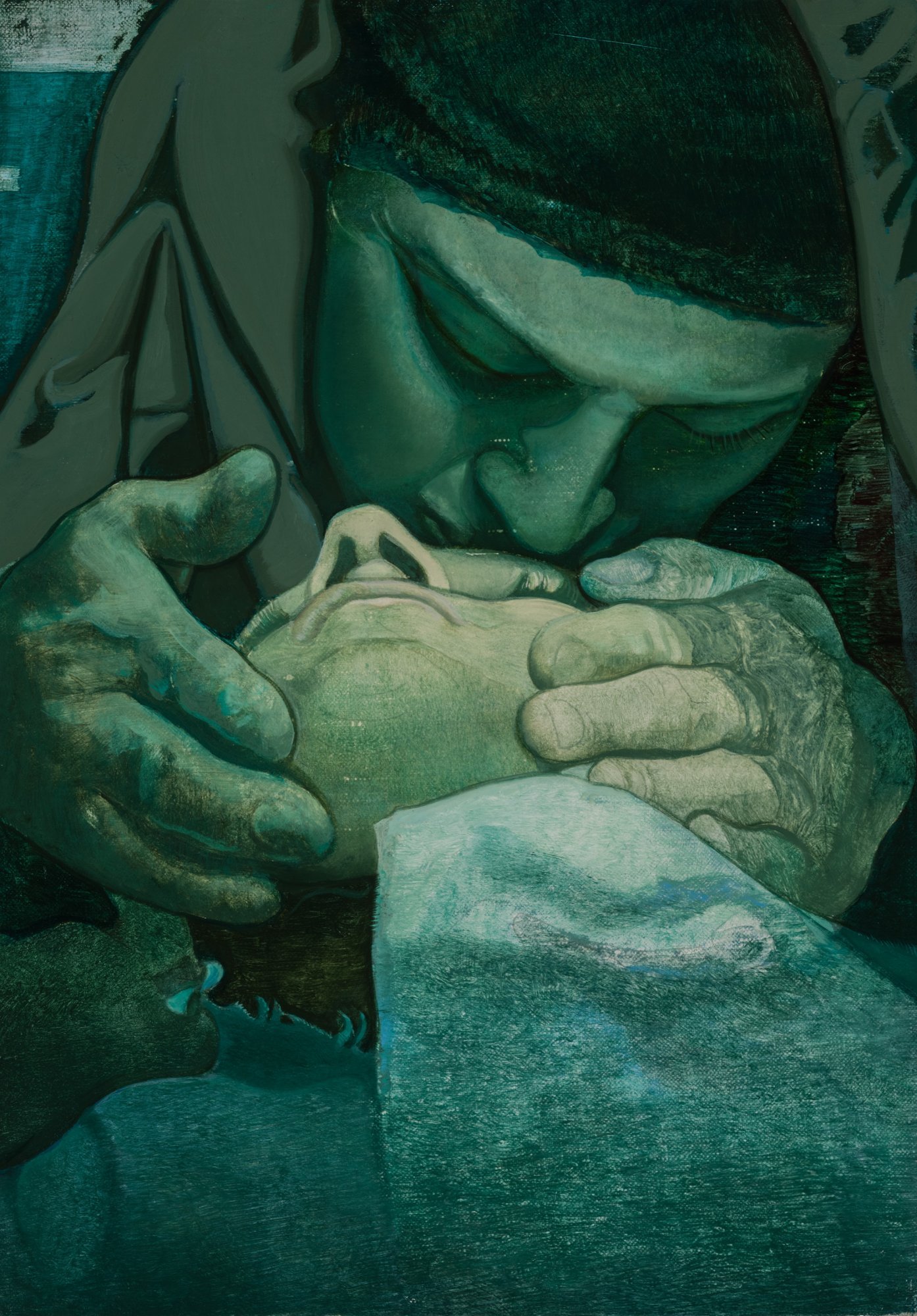
The exhibition features a small painting, one of the oldest in the Pinault Collection, titled Ombre sul giallo (or “Shadows on Yellow”), which portrays a kind of goodbye kiss between two figures. This poignant scene is depicted on a very small canvas, almost that of an icon, which gives it an almost religious tone. We cannot make out their gazes. The intensity resides in the relationship between these two figures. It is as if the viewer is being kept at some distance from this incredibly intimate scene.
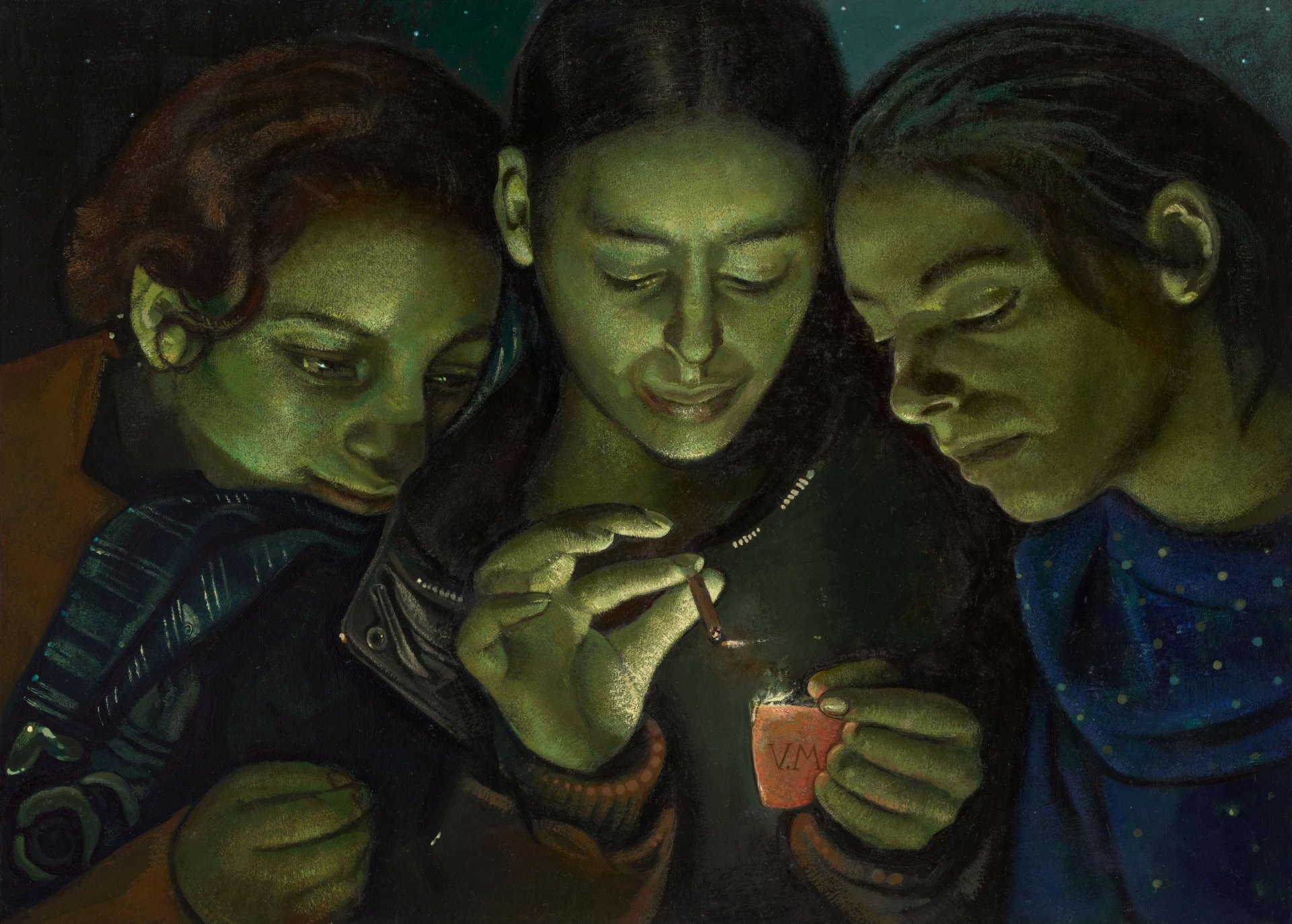
Visitors to this room will also encounter a self-portrait of Victor Man titled Umbra Vitae. The artist’s face appears within an x-ray of a woman’s skull, surely that of his companion, which is shown in profile to the right, the direction traditionally associated with the future in the history of painting. The presence of an old person’s hand, perhaps that of his father, also refers to the past, thereby creating a kind of dialogue between different timeframes and generations. Such a painting distils all the mystery of our existence. Man is also very clearly expressing his obsession with the connection between life and death in this work. In painting such a piece today, the artist shows us that painting holds a unique power that is different from that of film, photography, literature, or music. In particular, it is able to transcend realistic colours, as we can see in his very peculiar palette; the faces often have a green tinge, and some scenes are bathed in red. A filter seems to establish a distance from reality.
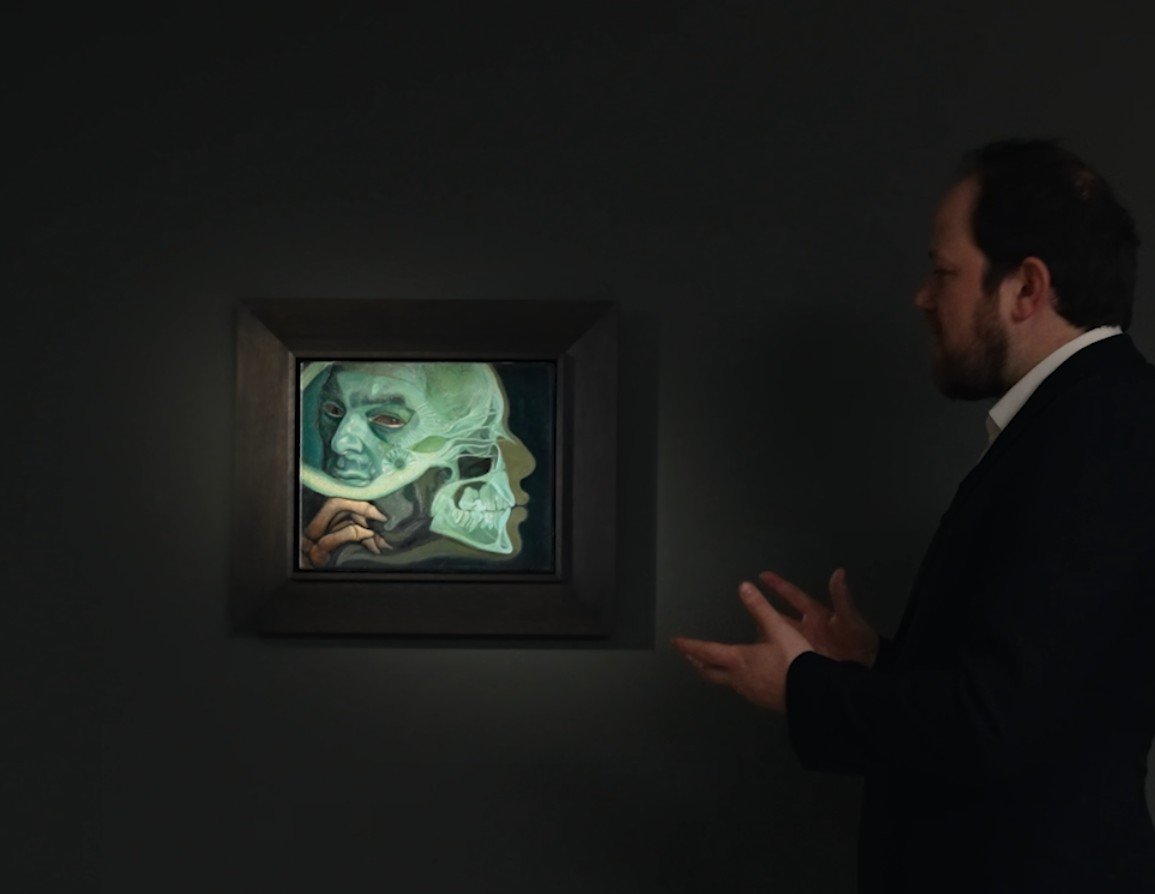
We have already seen this palette in the history of art: in Mannerism, which immediately followed the Italian High Renaissance, painters distorted bodies and coloured their flesh grey or green. This expressed a change in the relationship to the body and its representation.
Even when it comes to his subjects, Man provokes a sense of hesitation and doubt in the viewer. He does this by drawing on all of painting’s resources, especially the poses adopted in old portraits, which he transposes to the contemporary era. This is the case in Titiriteros (or “The Puppeteers”), for example, in which three women hold a burning piece of paper. All the attention is focused on this flame at the centre, which is burning a piece of paper, on which we can see the artist’s initials, “VM”. Man is staging his own demise in this work. And yet, this flame is too dim to produce all of the light that falls on the faces, as if something bigger were burning that we cannot see in the canvas. That is the enigma. The only explicit temporal clue is a leather jacket with a zipper and snaps, which grounds the scene in the present. At the same time, the work is steeped in a sense of fable and allegory, in something greater than ourselves, something more universal.
How does the lighting contribute to the experience of the exhibition?
The set design for this exhibition emphasises darkness. We worked with Man extensively on the lighting, the colour of the walls, and the physical relationship that viewers would have to the paintings.
The canvases are lit from only one side, which is rare. Museums generally try to get rid of shadows, but we embraced them. It gives the exhibition an almost theatrical quality, just as it intensifies the colours and the materiality of the oil painting.
Man pushes this experience even further with three small paintings that are almost entirely black, and which have been lit as dimly as possible. This obliges the viewer to spend more time with the work. The artist’s approach is especially interesting when we consider that, statistically speaking, viewers spend an average of just a few milliseconds looking at each painting when they visit a museum. We have to stay in front of this work for a few seconds and wait for our eyes to adjust before the details of the painting slowly emerge. These canvases are copies of older paintings, often dating back to the Italian Renaissance, which depict violent scenes: a saint being tortured by demons, pulled by his hair, struck, and beaten. Oddly, they resonate with contemporary forms of violence.
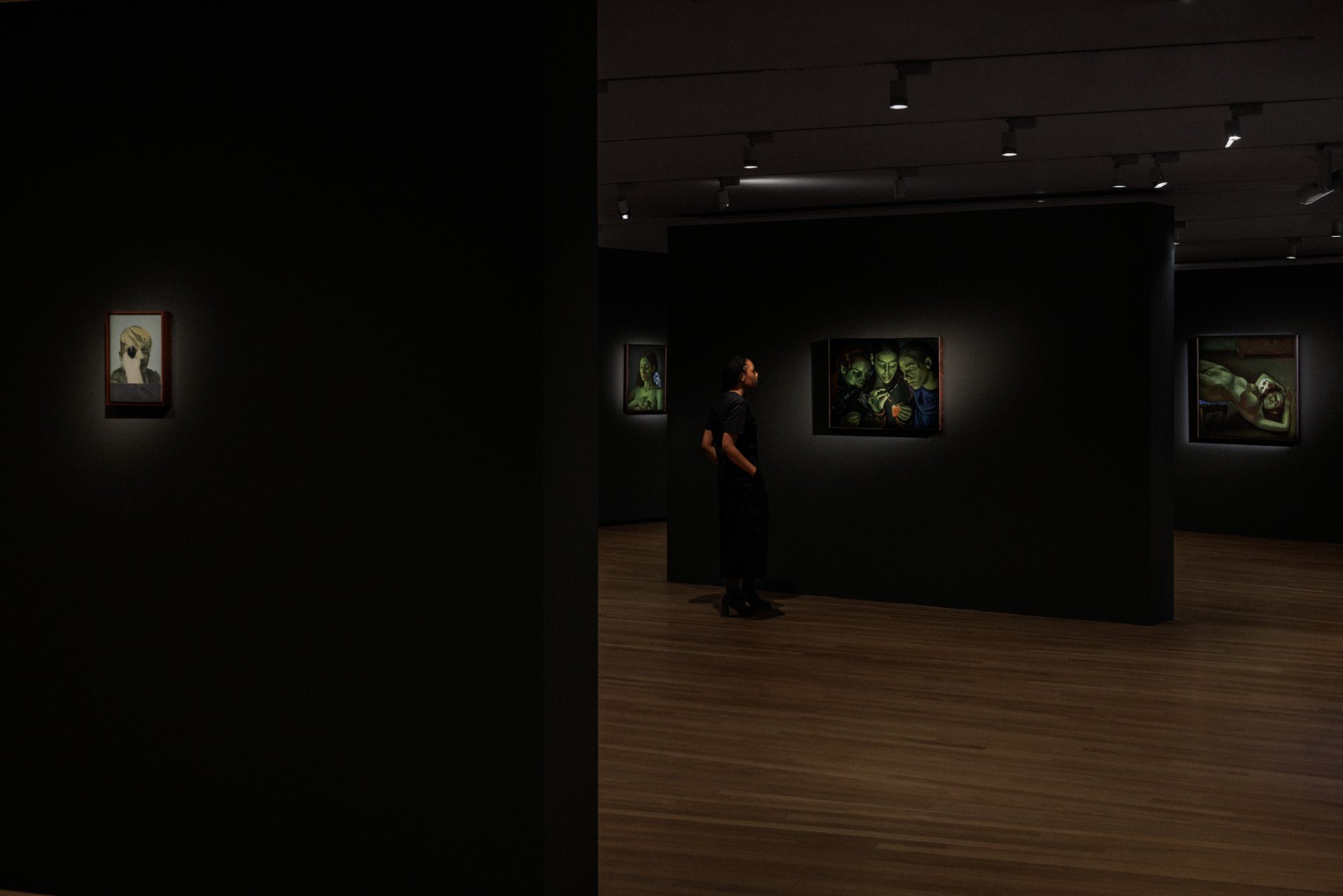
These paintings remain highly enigmatic. We have to devote some measure of time to them to be able to decipher them, and this is precisely what Man is playing with. He is dictating the amount of time that we have to spend looking in order to understand. Many people who see them wonder whether there is a light emanating from within the paintings, but in reality, without any external lighting, they are completely black. The scene only appears through this minimal lighting. Hung at the end of the exhibition, they also helps us reframe the work in terms of an older heritage, that of the depiction of violence in Western painting.
Essentially, the artist is saying that each painting is a vehicle for meditation, much like the religious works we see hanging in churches and museums. It is still possible to produce paintings today that are endowed with that same emotional power, and which are able to talk about essential human realities.
This is also what situates Victor Man at the very heart of the exhibition Clair-obscur at the Bourse de Commerce: his exploration of the deepest reaches of the human psyche, in its shadow areas as much as its bursts of light.
Victor Man’s works are being shown until 24 August 2026 as part of the exhibition Clair-obscur at the Bourse de Commerce – Pinault Collection in Paris.