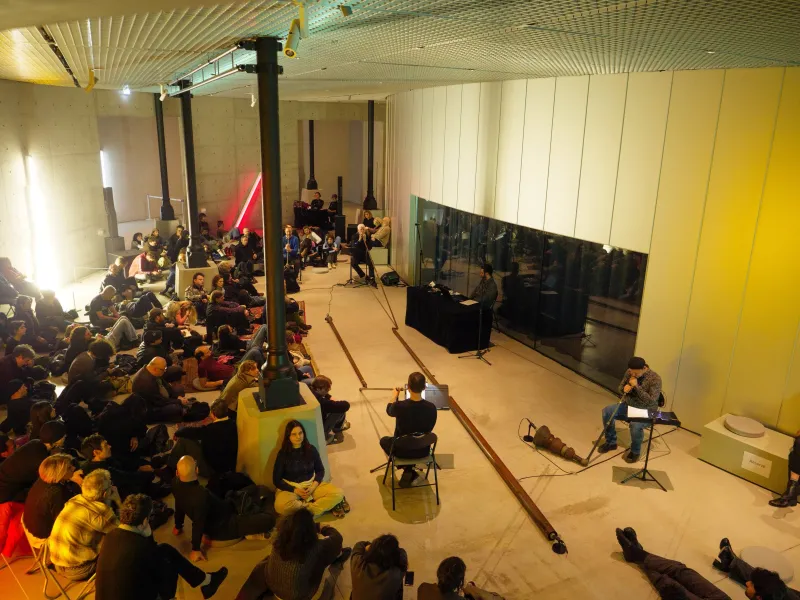
Yoshi Wada, Earth Horns with Electronic Drone
ARCHIVE
Ticket holders may arrive at any time, up to 30 minutes before the end of the concert.
The Bourse de Commerce and the New York–based label Blank Forms present Earth Horns with Electronic Drone by Japanese artist Yoshi Wada (1943–2021) for the first time in France.
Born in Kyoto in 1943, Yoshi Wada earned a degree in sculpture from Kyoto City University of Arts before moving to the United States in 1967. There, following his encounter with its founder George Maciunas, he joined the Fluxus movement and pursued advanced musical studies: composition with La Monte Young, North Indian vocal music with Pandit Pran Nath, and Scottish bagpipes with James McIntosh and Nancy Crutcher. These formative experiences shaped Yoshi Wada’s highly personal approach: a combination of experimentation with raw materials, a sense of duration, and a taste for acoustic phenomena.
In the early 1970s, Yoshi Wada created large blown horns - some measuring more than nine meters in length - the Pipe Horns, evoking oversized Tibetan and Alpine horns. These improvised instruments, amplified by contact microphones and filtered through oscillators and feedback circuits, produce powerful, resonant droning. In 1974, the public recording of Earth Horns with Electronic Drone documents his first explorations with these instruments.
As he would later explain: “At the time when I began making earth horns, I didn’t want to use traditional instruments. I was doing plumbing work for a living and picked up a piece of pipe, blew into it, and it created a very good sound. So, I began building instruments using plumbing pipes and fittings. I was proud of this. Building homemade musical instruments from scratch requires spending a lot of time experimenting.”
The modular electronic system, designed by Liz Phillips and Yoshi Wada, captures the sounds of the Pipe Horns in real time and produces a continuous electronic drone, which is fed back into the space to create a new sonic cycle. The result is a dynamic sound environment in which the primordial sounds of the Pipe Horns merge and are transformed through the purity of electronic tones.
“All changes become modulations of a single resonating acoustic environment,” wrote Yoshi Wada in the program notes for the original performance in 1974. “I am most interested in the effect, psychologically, of these subtle tones and movements on both players and audience alike, particularly when they are played over a long period.”
The electronic system was rebuilt using modern technologies by Ezra Buchla, in collaboration with Liz Phillips and Tashi Wada, with the generous support of the Bourse de Commerce, as part of an ongoing effort to preserve and present the art and legacy of Yoshi Wada.
Composer, artist, and pioneer of minimalist sound Yoshi Wada (1943–2021) was a fixture of New York’s experimental art scene for more than fifty years. Yoshi Wada has remained an important and widely influential figure for generations of artists and musicians. In the last decade of his life, Wada collaborated extensively with his son, composer and musician Tashi Wada, who now oversees his estate and archive.
Tashi Wada is a composer and performer based in Los Angeles. Wada studied composition at CalArts with James Tenney, and for many years performed alongside his father Yoshi Wada. He has presented his music internationally and collaborated with a range of artists including Charles Curtis, Simone Forti, and Julia Holter. Wada founded and runs the label Saltern. His most recent album, What Is Not Strange?, was released in 2024 by RVNG Intl.