Fujiko Nakaya: Video Works & Documentation
ARCHIVE
Admission with an Exhibition ticket
To mark the final days of Fujiko Nakaya’s Cloud #07156 in the Rotunda, the Bourse de Commerce presents a film program bringing together the artist’s video works and a selection of documentary footage tracing the history of her fog sculptures.
A pioneer of video art since the early 1960s, Fujiko Nakaya has explored the medium along two distinct paths. With the Video Hiroba collective, she used the camera as a tool for dialogue and testimony, recording situations and voices that received little coverage in mainstream media. At the same time, the flexibility and intimacy of video allowed her to explore, alone in front of the camera, simple gestures and elementary physical phenomena, such as balancing an egg on its end.
The program also traces the evolution of her fog sculptures, from her first experiments in 1969 to their development in both outdoor and indoor settings, across natural and urban environments.
Fujiko Nakaya – Video Works
- Friends of Minamata Victims – Video Diary, 1971–1972
B&W, sound, 20 min
Friends of Minamata Victims – Video Diary emerged during the first flourishing of video art, as the first portable video cameras were becoming commercially available. In 1971, Canadian artist Michael Goldberg persuaded Sony to lend him a video camera, which he circulated among Japanese artists with the aim of establishing an international communication network based on the exchange of video letters. Fujiko Nakaya responded to the initiative by choosing to highlight a crisis she felt was being overlooked: the mercury poisoning of residents of Minamata Bay caused by discharges from the Chisso chemical plant. By filming demonstrations outside the company’s headquarters, she observed how the presence of the camera galvanized the protesters.
- Old People Wisdom – Cultural DNA, 1973
In collaboration with Hakudo Kobayashi and Yuji Morioka. Excerpt. B&W, sound, 11 min (edited from 25 hours of footage)
Fujiko Nakaya visited retirement homes and associations to interview elderly people. She systematically asked them three questions: the first concerned their experiences and the advice they wished to pass on to future generations; the second, their principles in life; and the third, their dreams for the future. In doing so, she sought to preserve the voices of a generation that had lived before the intensification of social competition and Japan’s technological and economic boom. Drawn from 25 hours of footage, the excerpt is selected randomly by computer. The film was thus conceived as a social resource for future generations, drawing on this reservoir of wisdom.
- Statics of an Egg, 1973
B&W, sound, 11 min
This video is a continuous, unedited recording showing the artist balancing an egg on its tip. To find its center of gravity, she gently taps it with her fingertips until it stands upright. Statics of an Egg is part of a series of videos devoted to hand gestures, alongside Columbus Story (1973), Black Tea Bowls (1979), and Coordination: Right Hand/Left Hand (1979), in which Nakaya explores the relationship between movement and consciousness.
- Coordination: Right Hand/Left Hand, 1979
Color, sound, 8 min
In this video, Fujiko Nakaya films a close-up of two hands sharpening a pencil with a knife, revealing the differences between their movements. The right hand acts mechanically and repetitively, while the left responds to its gestures, adjusting and controlling the sharpening process through more complex, at times almost sensual movements. Coordination: Right Hand/Left Hand challenges preconceived ideas associated with each hand: in many cultures, the left is portrayed as impulsive and emotional, while the right is associated with rationality and productivity. The video thus invites us to reconsider and overturn these assumptions.
- Soji-ji, 1979
Excerpt. Color, sound, 18 min (edited from 60 minutes of footage)
Filmed at the Soji-ji Zen temple in Japan, the work documents the monks’ morning recitation of sutras. Each monk chants according to the rhythm of his own breath, pausing to breathe at a different moment while the collective recitation continues uninterrupted. Nakaya seeks to capture this continuity, like a deep river whose current flows on beyond individual pauses. Barely perceptible in the image, the rhythm of their breathing nevertheless becomes visible through the movement of the monks’ feet as they chant while walking. These subtle shifts between individual rhythms and the collective flow evoke ma, the Japanese concept of the interval as a relational space.
Fujiko Nakaya – Documentation
- Fujiko Nakaya and Thomas Mee. Tests for Fog Sculptures
1969, Thomas Mee’s garden, United States. 2 min 29 sec.
This video documents Fujiko Nakaya’s first experiments with “fog sculptures,” whose technical system was developed with the assistance of engineer Thomas Mee. Conducted in California in 1969, these tests took place one year before the artist’s fog sculptures were first presented publicly.
- Pepsi Pavilion, Fog Sculpture #47773
1970, Japan. 1 min 39 sec.
Created for Expo ’70 in Osaka, the Pepsi Pavilion was produced by E.A.T. (Experiments in Art and Technology), an organization that fostered collaborations between artists and engineers. Fujiko Nakaya created her first fog sculpture for the pavilion, enveloping the exterior of the building in a constantly transforming veil. Subject to wind and atmospheric conditions, the fog continually changed shape, making the climate itself the mold of the sculpture.
- Opal Loop/Cloud Installation, Fog Installation #72503
In collaboration with Trisha Brown (choreography). 1980. Excerpt. 5 min 19 sec.
In the choreographic work Opal Loop/Cloud Installation, created in collaboration with American choreographer Trisha Brown, Fujiko Nakaya’s fog unfolds sometimes in the background and sometimes across the stage, enveloping the dancers until they disappear and then reappear. Reflecting Nakaya’s involvement in the New York avant-garde, the work was also her first indoor fog sculpture.
- Foggy Forest, Fog Environment #47660
1992, Japan. 9 min 45 sec.
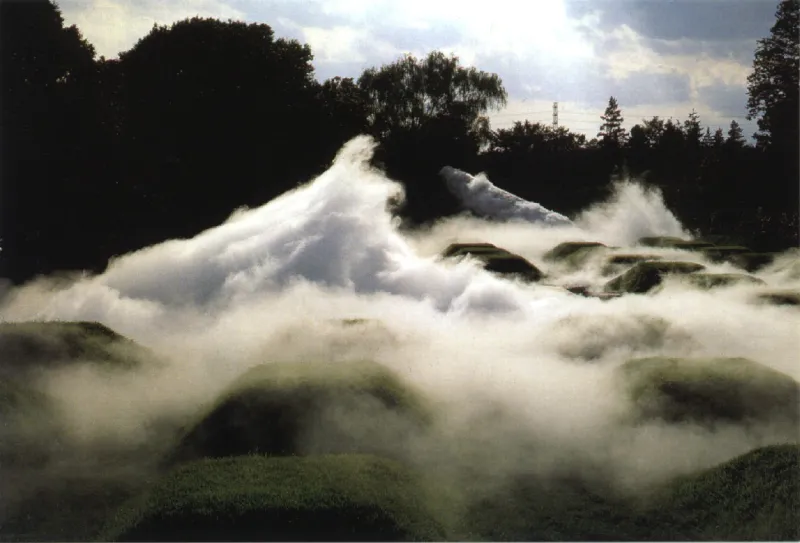
Foggy Forest is a permanent installation created in 1992 for the “Children’s Forest” at Showa Kinen Park, on the outskirts of Tokyo. Across a vast playground landscaped to contain and direct the fog, it spreads from a “basin” and a “waterfall,” shifting according to the wind and atmospheric conditions. Children are invited to move through this changing environment and experience the fog both visually and through touch. The work thus embodies Nakaya’s desire to integrate her fog sculptures into public space.
- F.O.G., Fog Sculpture #08025
1998, Spain. 4 min.
Commissioned from Fujiko Nakaya by Robert Rauschenberg for his retrospective at the Guggenheim Bilbao, F.O.G. unfolds around the building and the bridge on its north side, extending to the pool bordering the museum, where it interacts with Yves Klein’s Fire Fountain. Its title takes its initials from Frank O. Gehry, the museum’s architect.
- Moss Garden Nicey-sur-Aire, Fog Sculpture #07172
2012, France. 3 min 45 sec.
Moss Garden Nicey-sur-Aire is a permanent installation created along the Aire River in the Meuse region. Developed with the participation of local residents in the manner of a Japanese garden, and using local natural materials, the site is crossed by banks of fog that rise on either side of the river, fall into it and follow its flow, shifting with the wind.
- Fog Square – Freedom Fog, Fog Installation #07156R
2013, France. 5 min 13 sec.
Created for Nuit Blanche 2013, Fog Square brought an ephemeral fog sculpture to Place de la République in Paris, transforming the perception of the square for the duration of a single night. A vast curtain of fog falls over passers-by, while veils of mist envelop the statue of the Republic.
- Standing Cloud, Fog Sculpture #07240
2013, France. 4 min 25 sec.
Created at the Domaine de Chaumont-sur-Loire, in the Prés du Goualoup, Standing Cloud is a fog sculpture installed near a grove of birch trees. Rows of nozzles suspended high in the trees release fog above visitors as they venture onto a small wooden platform.
- For Louisiana, Fog Garden #47662
2016, Japan. 1 min 58 sec.
Presented in 2016 at the foot of the Yebisu Garden Place Tower in Tokyo’s Yebisu Garden Place urban complex, For Louisiana revisits a concept developed for a 1982 performance (Kata-no-Taiko, Fog Performance #47605). Dump trucks appear to unload fog: as their beds tilt, the fog pours out in a cascade, bounces off the ground, and rises again, forming a cloud in constant transformation.
- London Fog, Fog Performance #03779
2017, United Kingdom. 4 min 15 sec.
London Fog (2017) is a fog sculpture created by Fujiko Nakaya on the terrace of Tate Modern in London. Accompanied by a sound composition by Ryuichi Sakamoto and a lighting installation by Shiro Takatani, the work transforms the space in rhythm with the changing fog. Dancer Min Tanaka performed there on several occasions, creating a subtle dialogue between the body and the mist.
- Khao Yai Fog Forest, Fog Landscape #48435
2025, Thailand. 2 min 20 sec.
Khao Yai Fog Forest (2025) is a permanent installation by Fujiko Nakaya located in the forest of the same name in Thailand. The largest fog sculpture created by the artist to date, it extends across several hectares of landscape specially shaped to guide the movement of the fog. It forms part of an ecological regeneration project in which art, landscape, and the environment become one.
A selection of films by art critic and theorist Anne-Marie Duguet, author of the first monograph devoted to Fujiko Nakaya, Anarchive No. 5 – Fujiko Nakaya (Les Presses du réel, 2012).