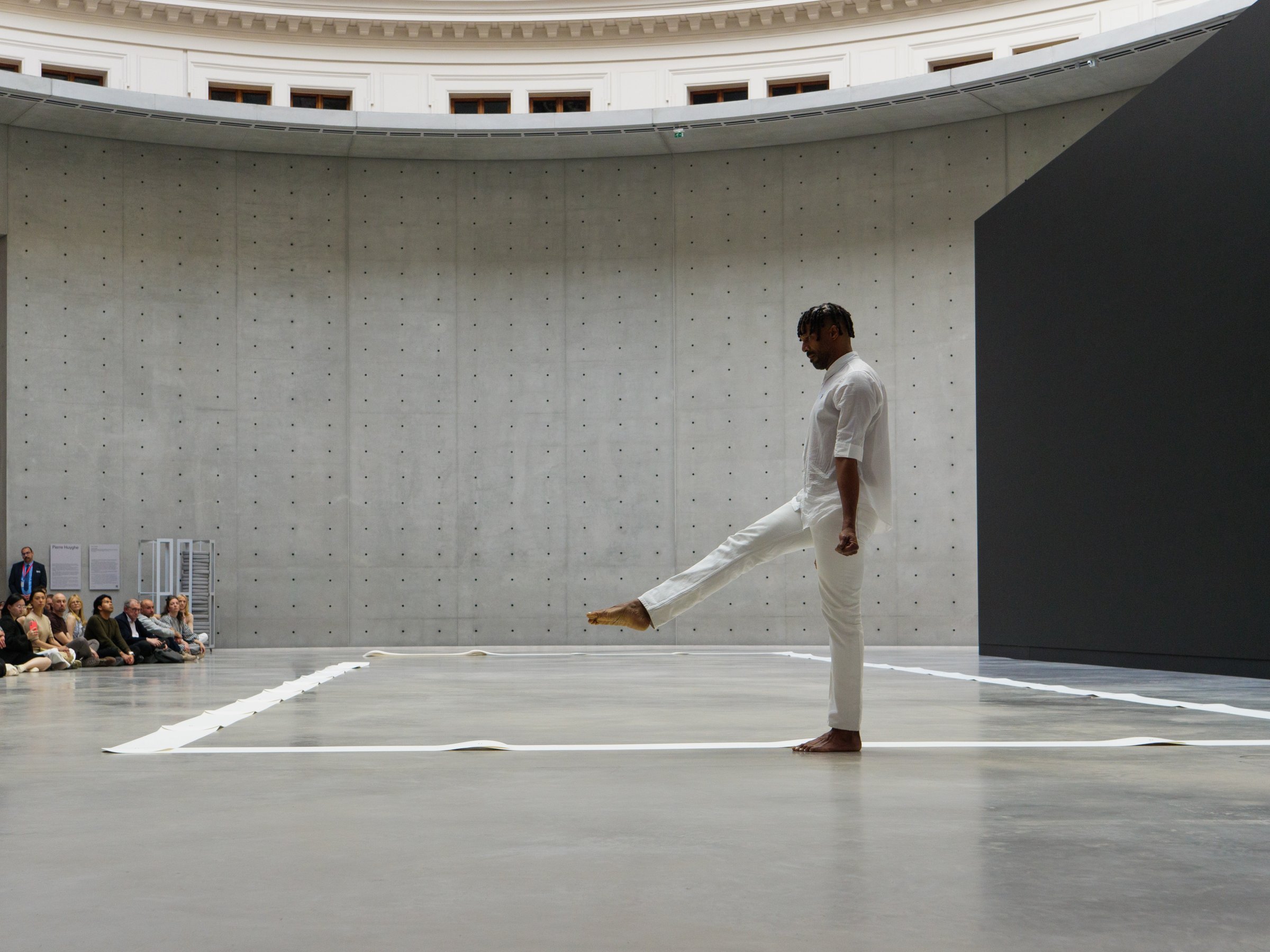
James Lee Byars, The Mile-Long Paper Walk
ARCHIVE
In resonance with the works of James Lee Byars presented in Gallery 2 as part of the “Clair-obscur” exhibition, the Bourse de Commerce presents, for the first time in Europe, the performance The Mile-Long Paper Walk (1965) in the museum’s Rotunda.
Throughout his career, James Lee Byars (1932-1997) created a body of performances that form a fundamental part of his work. Through garments, accessories, and objects, he temporarily transforms relationships between bodies, in an approach that is both everyday and grandiose. The Mile-Long Paper Walk (1965) is the first “performable object” conceived by the artist. A folding ruler made of sheets of Japanese paper, it forms a long 152-meter-long line that seems to extend virtually to infinity when fully unfolded. Investing a surveyor figure, the Paper Walk opens up an architectural and landscape visual field.
First activated by American choreographer Lucinda Childs in the atrium of Pittsburgh's Carnegie Museum in 1965, the work has remained little known for a long time. The dancer, dressed in a remarkable white feather costume, unfolded this white ribbon into a series of geometric shapes.
Now presented at the Bourse de Commerce, the piece is reactivated by Jimmy Robert, who since the 2000s has made paper - printed, folded, manipulated - one of his preferred medium. In 2014, he had already taken part in the second and final activation of The Mile-Long Paper Walk at the MoMA in New York.
Originally from Detroit, Michigan, in the United States, James Lee Byars (1932-1997) was an artist whose work is characterised by a never-ending pursuit of the absolute, the ephemeral, and perfection. His practice constantly pushed against the boundaries between art and life, often combining performances, sculptures, and installations. In 1957, after studying art and philosophy, Byars was awarded a fellowship that enabled him to take a spiritual and artistic journey to Kyoto, where he remained until 1963. Japanese culture had a strong influence on his practice. Throughout his career, he continued to travel across Europe, Asia, and Africa, living a nomadic life that nurtured his adoption of art as a total experience. Through his works, he developed what he called “the first totally interrogative philosophy”, an artistic practice that sought to exceed the limits of human knowledge by creating highly poetic objects, books, and performances. In his works, he forged bonds between the most extreme opposites: the monumental and the minuscule, the universal and the personal, and the evanescent and the spectacular.