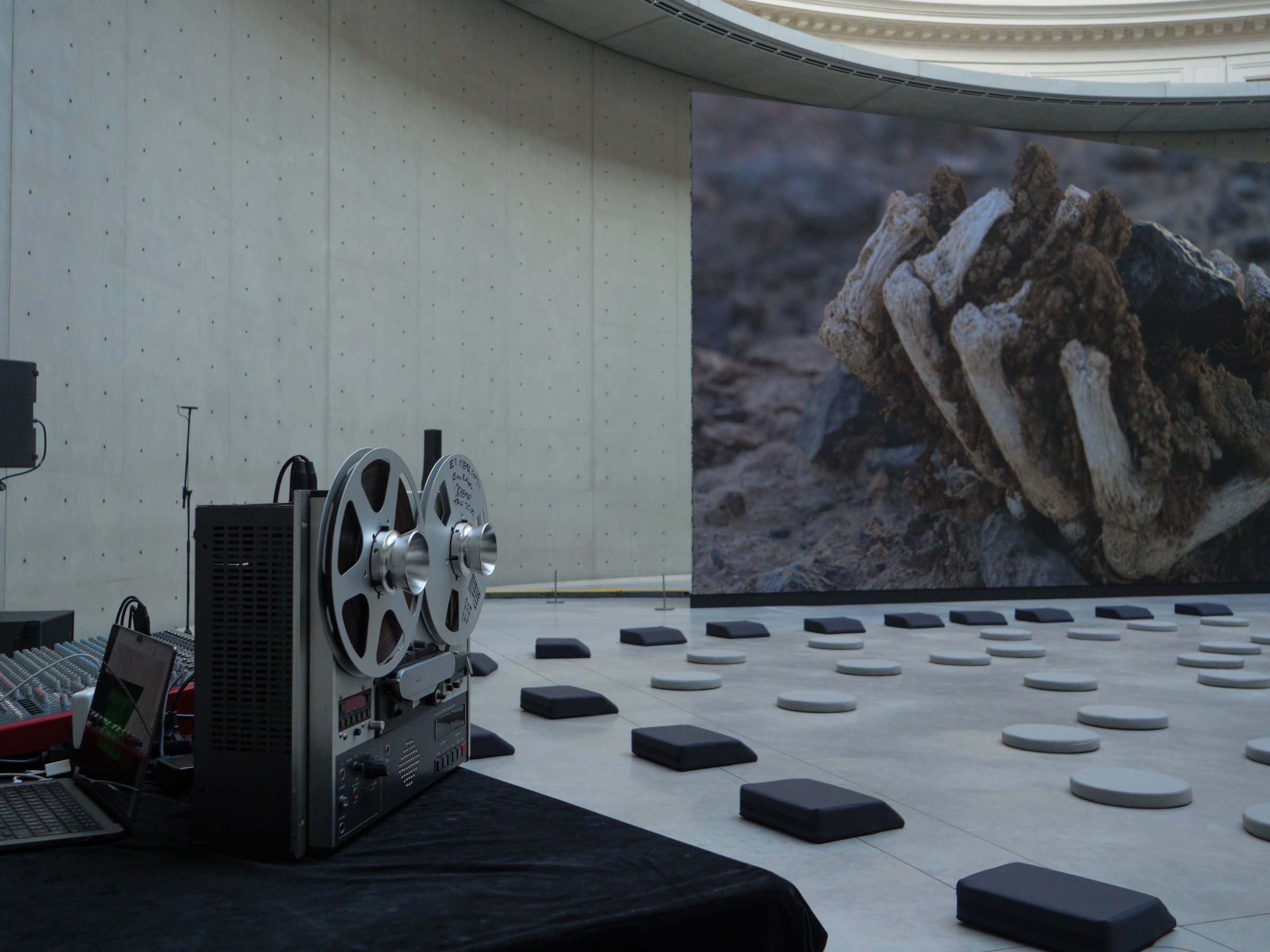
Éliane Radigue, Kyema
ARCHIVE
In resonance with the exhibition “Clair-obscur” the Bourse de Commerce presents in the Rotunda, where Pierre Huyghe’s film Camata unfolds, the musical work Kyema (1988) by Éliane Radigue (1932-2026), composer and pioneer of electronic music, broadcast live by François J. Bonnet. The performance extends a sensitive reflection on time, ritual, and states of transformation.
Listening to Kyema, a drone emerges, neither dull nor bright. It vibrates and transforms through minute oscillations, generating sequences that overlap or unfold in isolation — never quite identical, never entirely repeated.
This program had already been presented in November 2024 as part of the exhibition “Pierre Huyghe. Liminal” at Punta della Dogana in Venice. In collaboration with François J. Bonnet, the composer had agreed to its reprise under the dome of the Rotunda at the Bourse de Commerce as part of “Clair-obscur”. Following her death on February 23, 2026, the concert is being maintained in accordance with her family’s wishes.
Program
- 7:30PM : the music Point, a presentation of Éliane Radigue’s work by French music journalist Joseph Ghosn (Auditorium)
- 8PM : Kyema (1988) by Éliane Radigue, broadcast by François J. Bonnet (Rotunda)
Kyema belongs to the Trilogie de la Mort, created between 1985 and 1993 and widely considered Éliane Radigue’s masterpiece. A long sonic meditation on death, nourished by her engagement with Tibetan Buddhism, it comprises three one-hour pieces for ARP 2500 synthesizer: Kyema, Kailasha, and Koumé.
Kyema draws inspiration from the Bardo Thödol, or Tibetan Book of the Dead, and unfolds in six sections corresponding to the six bardos — intermediate states of life and death — that trace the existential continuity of a being: birth, dream, contemplation, death, clear light, and finally passage and return.
Shortly after completing Kyema in 1988, Éliane Radigue learned of the tragic death of her son Yves in a car accident. Two weeks later, she began composing Kailasha, named after the most sacred of Tibetan summits, Mount Kailash. Although a journey to this site -regarded as the center of the world in Tibetan cosmology - was impossible for her, the work functions both as a sonic pilgrimage and as a memorial dedicated to her son. She completed it in 1991. A subsequent journey to Nepal, on the occasion of the cremation of her Tibetan master, confirmed for her the transcendent dimension of death, understood as perpetual becoming. This experience resonates throughout Koumé, completed in 1993, thus concluding the trilogy. Trilogie de la Mort is presented in November 1993 at the Cimiez monastery in Nice, where sound diffused through concealed loudspeakers seemed, according to minimalist composer Tom Johnson, to emanate from the walls themselves.
The analog tape used for the concert comes from an edition produced from the original master by the New York publisher Blank Forms.
About Éliane Radigue
Born in Paris, Éliane Radigue began her musical training at an early age, first studying piano, then harp, voice, and composition. It was through contact with musique concrète, working with Pierre Schaeffer and later Pierre Henry, that her music found its true path.
Over more than fifty years, her work unfolds across three distinct periods, each marked by rupture and by an exploration of thresholds, intervals, and the relationships between listening experience, inner dimension, and personal trajectory.
An initial phase (1968–1971) focused on feedback and reinjection processes — an embryonic period already signaling extreme meticulousness and a concern with thresholds and precarious balances. This was followed by a long period of electronic compositions (1971–2001), dominated by the use of the ARP 2500 synthesizer and by the development of extended forms with subtle variations, inscribing her music within a duration attentive to the unfolding of time. Since the 2000s, her work has turned toward acoustic creations in close collaboration with trusted musicians, expanding her practice toward a more collective and relational dimension.
Throughout her life, Éliane Radigue developed a demanding and singular body of work that continues to influence many generations of musicians. She passed away on February 23, 2026.
About François J. Bonnet
François J. Bonnet is a composer, theorist, and director of the Groupe de Recherches Musicales at the Institut National de l’Audiovisuel (INA GRM) since 2018. His music, often released under the project Kassel Jaeger, is presented internationally in major festivals and institutions. He has collaborated with artists including Éliane Radigue, Stephen O’Malley, and Jim O’Rourke. Author of several essays — including La musique à venir (2020) and Après la mort (2017) — he is also a producer for France Musique (L’Expérimentale) and co-editor of the journal SPECTRES (Shelter Press) as well as the record series Recollection GRM and Portraits GRM.
Joseph Ghosn is a journalist and author of several essays on music. Deputy editorial director of Madame Figaro, he previously led the editorial teams of Vanity Fair, Grazia, and Les Inrockuptibles. For France Musique, he participates monthly in the program L’Expérimentale, produced by INA-GRM.
Kyema (1988)
Length : 61’22”
ARP 2500 synthesizer on magnetic tape
Creation in the composer’s studio in Paris
Premiered December 17, 1988, New Langton Arts, San Francisco
First part of the Trilogy of Death
First part of « Trilogie de la Mort ».
« États intermédiaires
... à mon fils, Yves Arman
Inspired by the root text of the “Bardo Thödol” (the Tibetan Book of the Dead), this piece evokes the six intermediate states of consciousness that make up the existential continuity of being.
1. Kyene - la naissance (birth)
2. Milam - le rêve (dream)
3. Samtem - la contemplation (contemplation)
4. Chikal - la mort (death)
5. Chönye - la claire lumière (clear light)
6. Sippaï - traversée et retour (passage and return) »