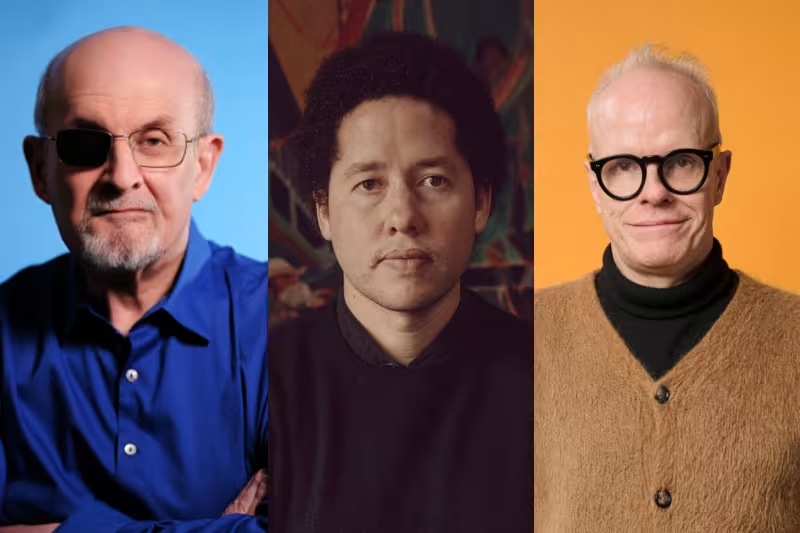
On the occasion of the exhibition “Michael Armitage. The Promise of Change” currently on view at Palazzo Grassi, an exceptional Art Conversation featuring award-winning writer Salman Rushdie, curator Hans Ulrich Obrist, and artist Michael Armitage.
The conversation is inspired by the themes explored in the exhibition and by the accompanying catalogue, edited by Hans Ulrich Obrist and featuring, among its critical contributions, a previously unpublished text by Salman Rushdie, published by Palazzo Grassi – Pinault Collection and Marsilio Arte.
The event offers audiences a unique opportunity to gain deeper insight into Michael Armitage’s artistic practice, through reflections that weave together images, literature, curating, and contemporary artistic creation. The conversation brings different cultural and intellectual perspectives into dialogue, opening a broader reflection on memory, social transformation, and the role of art today.
At the end of the event, visitors will have the opportunity to purchase the exhibition catalogue signed by all three participants.
The event will be live streamed here:
English
Italian
Some seats are reserved for Pinault Collection Members.
Salman Rushdie is the author of 23 books and has won many awards including the Booker Prize (UK) and the Premio Grinzane Cavour (Italy). He has collaborated with several artists including Bhupen Khakhar and Francesco Clemente. His work has been translated into more than 40 languages.
Hans Ulrich Obrist (b. 1968, Zurich, Switzerland) is Artistic Director of Serpentine in London, and Senior Advisor at LUMA Arles. Prior to this, he was the Curator of the Musée d’Art Moderne de la Ville de Paris. Since his first show World Soup (The Kitchen Show) in 1991, he has curated more than 350 shows.
Michael Armitage lives and works between Nairobi and London and is regarded as one of the leading voices in contemporary international painting. His works interweave references to Western art history, African visual culture, and contemporary current affairs, resulting in a layered and deeply political form of painting.