Sigmar Polke, Axial Age - Influences and Affinities
ARCHIVE
The Bourse de Commerce invites art historians Gloria Moure and Nelly Gawellek, in conversation with Emma Lavigne, Director General of the Collection and curator of the exhibition "Clair-obscur", to share their perspectives on the mysterious paintings of the monumental Axial Age cycle (2005-2007) by German artist Sigmar Polke, presented in Gallery 2 as part of the “Clair-obscur” exhibition.
Composed of nine panels, Axial Age refers to the concept of the “Axial Age” theorized by philosopher Karl Jaspers, which designates the period of Antiquity (800-200 BCE) as a moment of exceptional spiritual vitality, marked by thinkers such as Confucius, Buddha, Homer, and Plato.
Axial Age unfolds a sacralized and enigmatic space, oscillating between opacity and transparency, between the organic nature of matter and transcendence. The figures and motifs that emerge suggest a lost golden age and question the place of spirituality in the contemporary world.
During the 1980s, Sigmar Polke combined traditional techniques - grisaille, gold and silver leaf, precious pigments such as lapis lazuli or malachite - with modern materials - acrylic, resin, toxic pigments, metallic components - creating a true alchemy of form. In Axial Age, he applies a violet pigment to figurative motifs on a very fine synthetic fabric, creating visual layers and iridescent textures.
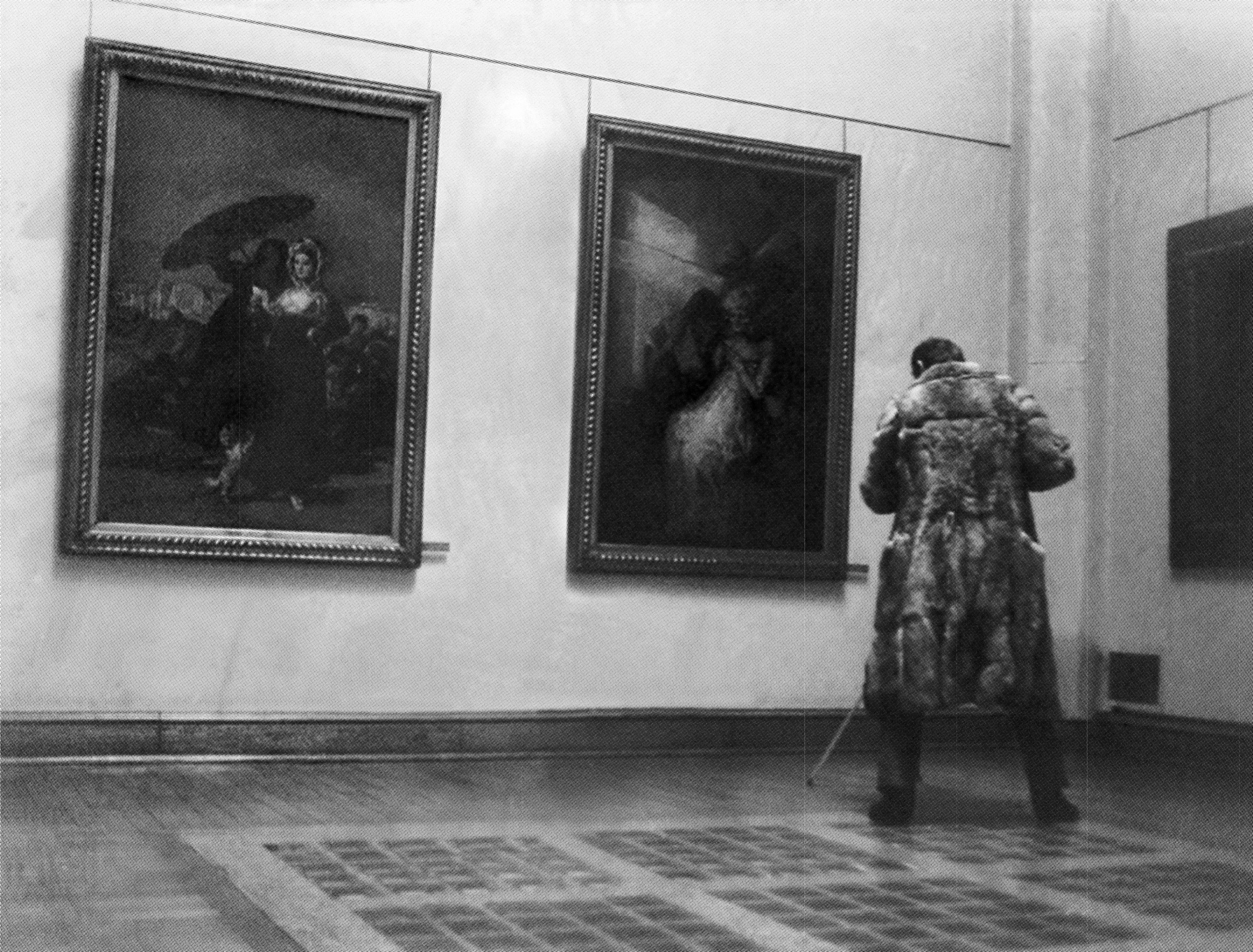
Since the early 1980s, Sigmar Polke’s use of unconventional materials and colors has earned him the label of a “painter-alchemist.” During their conversation with Emma Lavigne, Gloria Moure and Nelly Gawellek retrace the origins of his experimental approach as well as the diversity of his influences, from philosophy and the history of painting to the work of his predecessors. Among them, Francisco de Goya - whose work Las viejas (The Old Women, c. 1812) he discovered in 1982 - acted as a catalyst for his artistic development and confirmed his vision of painting as a deep, layered sedimentation of the contradictions of human experience.
Nelly Gawellek is an art historian and project director at the Anna Polke Foundation since 2018. She leads an oral history project on Sigmar Polke and has organized several artistic projects, including the anniversary project Productive Image Interference for Polke’s 80th birthday. She previously worked as a research associate for the Sigmar Polke estate, contributing to the catalogue raisonné and supporting international exhibitions. As an independent researcher and art historian, she focuses on contemporary art and serves voluntarily on the board of And She Was Like: BÄM!, a feminist network for art and culture.
Gloria Moure is an art historian and critic. An independent curator since the late 1970s, she was one of the first women to direct a museum in Spain. She has organized numerous international exhibitions, including the Marcel Duchamp retrospective (1984), and led the Fundació Espai Poblenou and the Centro Galego de Arte Contemporánea (CGAC), contributing to their international recognition. She has been a member of the advisory committee of the Museo Reina Sofía and has participated in cultural and urban projects in Barcelona. As an associate editor at Ediciones Polígrafa, she directs the Collection 20/21 series, dedicated to contemporary artists, and continues to publish and support contemporary art internationally.