Tadao Ando & Mono-ha. The Five Elements
Pinault Collection celebrates at the Punta della Dogana Tadao Ando, the architect behind its three museums. Bringing together Ando’s work and collector François Pinault’s passion for art, this unprecedented exhibition places the architect’s photographs in dialogue with major works by the Japanese Mono-ha movement (“School of Things”). Both legendary and little known, this movement remains one of the best-kept secrets of the late 1960s avant-garde. Today, the Pinault Collection holds one of the most remarkable ensembles of Mono-ha works outside Japan.
For more than twenty-five years, François Pinault and Japanese architect Tadao Ando (born 1941) have shared a relationship founded on deep trust and mutual respect. This exceptional collaboration has given rise to several landmark projects in which contemporary architecture and works of art engage in dialogue with the history of their settings. From Palazzo Grassi (2006) and its Teatrino (2013) to Punta della Dogana in Venice (2009), and finally the Bourse de Commerce in Paris (2021), Tadao Ando has reinvented these historic buildings, giving them a new purpose.
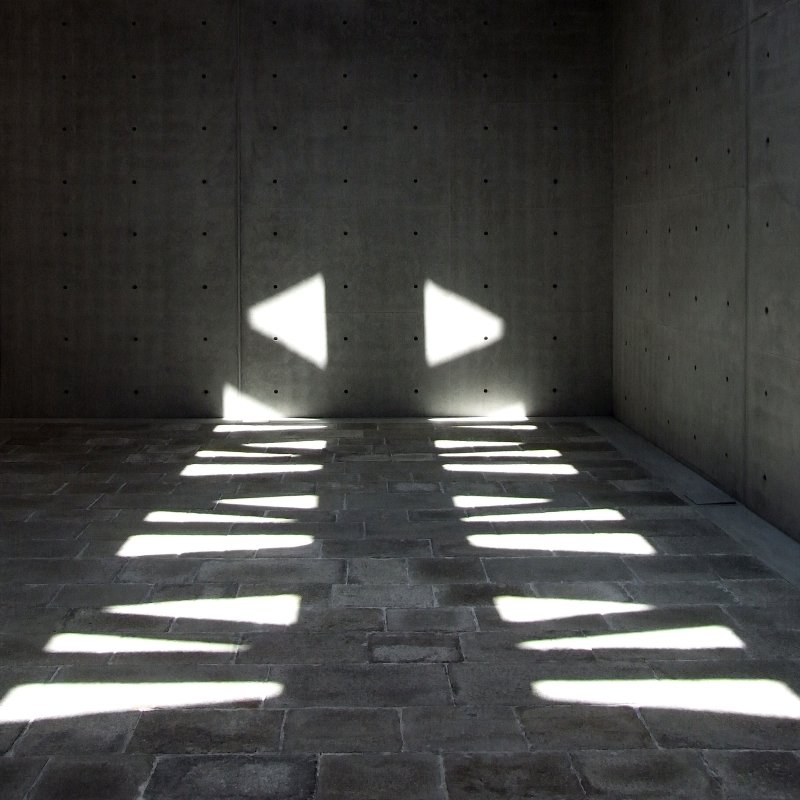
Focusing on the photographs Tadao Ando takes of his own architectural creations, the exhibition sheds light on a lesser-known aspect of his practice. Bringing together several hundred images, some of which are being shown for the first time, it highlights the architect’s longstanding exploration of the relationships between image, architecture and the experience of space. Presented as prints and slide projections within the bare architectural setting of Punta della Dogana, this photographic collection reveals Tadao Ando’s fascination with the changing qualities of light, the interplay of shadows and the passage of time.
Five elements, which also happen to be Tadao Ando’s preferred materials, provide a guiding thread throughout the exhibition: air (emptiness and the concept of ma, the space between things); earth (context and history); water (fluidity); fire (the transformation of glass or metal); and concrete, the material through which the architect gives form to abstraction.
These fundamental concepts resonate with the practices of several Japanese artists of the same generation, collectively known as Mono-ha. Emerging amid the upheavals of 1968 in Tokyo, Mono-ha took shape within the art schools of Tama and Tokyo, where young artists such as Nobuo Sekine, Kishio Suga, Lee Ufan and Jiro Takamatsu began exploring a radical form of art centred on materials, space, relationships and the perception of reality, seeking to establish a contemporary aesthetic free from Western influence. Choosing simple, everyday materials and arranging them in installations of pared-back forms, Mono-ha artists sought to awaken a deeper sensitivity in individuals. At a time when consumer society and mass media were expanding rapidly, they drew attention to the very existence of mono—the non-human “things” that surround us and form the fabric of the world.
Curated by Jean-Marie Gallais, Curator, Pinault Collection, and Nicolas-Xavier Ferrand, Researcher, Pinault Collection